


Digging for stories in a Gold Rush town that vanished in flames 170 years ago. Pinging brainwaves for reactions from sentences that slide between Spanish and English. Fortifying students’ skills and confidence with a practice called powerwriting.
These ventures are among nearly a dozen UC Merced research projects made possible by the Chancellor’s Catalyst Awards, an initiative designed to spur compelling inquiry in the humanities and social sciences.
The awards support 11 projects powered by the talents of more than two dozen professors. Chancellor Juan Sánchez Muñoz allocated a total of $202,000 to fund the projects during the 2026-27 academic year.
“As higher education nationwide faces headwinds in the funding of academic research, I am proud to support the meaningful work being done in UC Merced’s School of Social Sciences, Humanities and Arts to deepen understanding of who we are and where we’re going,” Muñoz said.
Nearly every project is led by professors from more than one academic discipline — literature and history, for instance, or philosophy and public health. In addition, six projects will involve graduate and undergraduate students as members of the researcher teams.
School Dean Leo Arriola said the awarded projects combine talent and expertise toward a single goal. “They are emblematic of the interdisciplinary collaboration that SSHA stands for,” he said.
A closer look at three Chancellor’s Catalyst awardees:
Unearthing Secrets of a Gold Rush Town
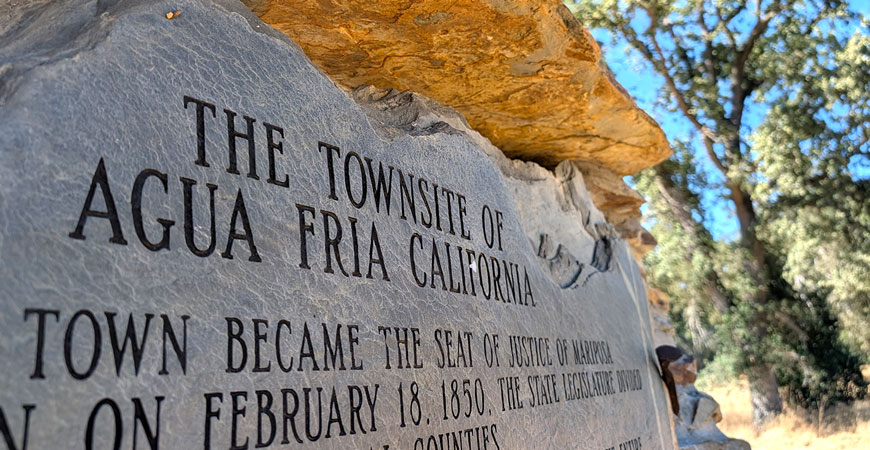
Agua Fria was a thriving California Gold Rush town in the Sierra foothills that once served as the seat of Mariposa County. It attracted a spectrum of fortune-seekers and settlers: Mexicans and Chileans, U.S. East Coasters and Europeans, Chinese and Indigenous people.
And then it was gone. The settlement named “cold water” in Spanish was consumed by fire after roughly five years of existence. Today, a stone marker along a rutted road off Highway 140 is the only visible evidence the town was there.
Anthropology Professor Beth Scaffidi and history Professor David Rouff will lead an archaeological project to uncover Agua Fria’s buried remains, thought to include roughly 75 structures, and piece together the lives of those who lived there. Undergraduate students will conduct excavations, catalog artifacts and search for historical records.
“Much of the town’s written history is missing or, at least, less developed,” Scaffidi said. “So archeology is a great tool for trying to fill those gaps.”
Eavesdropping on the Bilingual Brain
Code-switching — moving between two languages in conversation, sometimes in mid-sentence — is common among bilingual speakers. Researchers in this project will delve into what this does in the listening brain. Study participants’ brain activity will be monitored as they listen to bilingual passages in Spanish and English. Participants will then be tested on how well words are remembered at the point of a language switch.
“People should be better able to remember the words that happened at a code switch if the language was more salient or informative to them,” said cognitive science Professor Kristina Backer, a project lead along with cognitive science Professor Zenaida Aguirre-Muñoz and Spanish linguistics Professor Dalia Magaña.
The findings could influence an ongoing debate in bilingual education over whether mixing languages in the classroom can improve learning. “We want to maximize the ways we can increase students’ deeper comprehension of what they read,” Aguirre-Muñoz said.
Tapping the Power of Human-centered Writing
In a world where people can use artificial intelligence to generate paragraphs of polished text in seconds, researchers will test whether a technique called powerwriting can promote keeping human thinking front and center.
The method urges students to pause mid-draft, question their reasoning and apply any thoughts to what they’re writing. Powerwriting is designed to build confidence in their expressions and themselves.
The project will add powerwriting sessions to existing courses. Students will take surveys that measure confidence before and after the instruction. Student researchers will help design prompts and interviews.
Writing studies Teaching Professors Susan Varnot and Paul Gibbons are the lead researchers, as are public health Teaching Professor Lindsay Crawford and medical education Teaching Professor Susan DeRiemer.
On Sept. 11, Goldberry Long, a UC Riverside creative writing professor and an expert on powerwriting, will lead a seminar for faculty at UC Merced on using the technique in the classroom.
Varnot said powerwriting helps people overcome composition anxiety and tap into an instinctual mode that challenges assumptions and expands self-inquiry. Gibbons added that “writing is a process, but it’s also an experience. In order to write, I need to be able to question and reflect.”
Other projects supported by the Chancellor’s Catalyst Awards will study short-form digital media’s effect on children’s attention, explore Persian design influences in Yosemite’s Ahwahnee Hotel, and investigate references to vaccine skepticism in newsletters from members of Congress.
“SSHA has an amazing range of disciplines, from arts to cognitive science,” Arriola said. “These research awards promote the cross-discipline collaboration and student opportunities for which we excel.”
 Public Information Officer

