


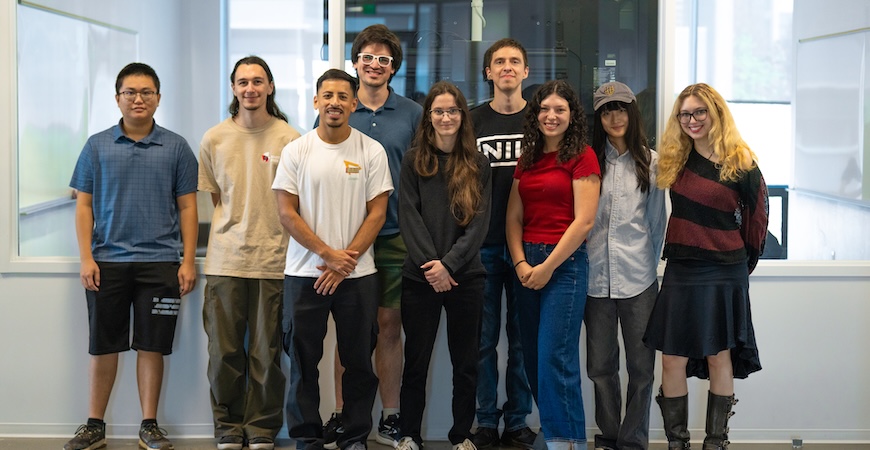
A five-year, $4.5 million T32 institutional training grant from the National Institutes of Health will establish a new doctoral training program at UC Merced for students pursuing careers in biomedical research.
The Interdisciplinary Cellular and Biomolecular Dynamics Training and Education program, known as InCuBaTE, will support up to 16 graduate students with two years of research funding while providing interdisciplinary coursework, hands-on technical training, professional development and a broad mentoring network.
InCuBaTE builds on the training structure UC Merced developed through the earlier NIH-funded Graduate Research Training Initiative for Student Enhancement (G-RISE)program and infrastructure from the NSF-funded Center for Cellular and Biomolecular Machines and expands that work through a research-intensive institutional training grant. The award is led by physics Professor and CCBM co-director Ajay Gopinathan, along with bioengineering Professor and CCBM co-director Victor Muñoz and chemistry and biochemistry Professor Andy LiWang. The wider leadership team includes Professor and chemical and materials engineering Chair Kara McCloskey, applied mathematics Professor Suzanne Sindi and Health Sciences Research Institute Director Katrina Hoyer, with CCBM Executive Director Carrie Kouadio serving as Career Development lead.
"UC Merced has developed real strength at the intersection of the physical sciences, engineering and biology," Gopinathan said. "InCuBaTE brings those areas together in a structured program so students learn to approach biomedical questions from more than one disciplinary perspective."
Students are recruited from six graduate groups: applied mathematics, bioengineering, chemistry and biochemistry, materials and biomaterials science and engineering, physics, and quantitative and systems biology. The first full cohort of 16 students was selected earlier this year.
Each trainee receives a standard graduate student researcher salary, tuition and benefits for the first two years of doctoral study, along with travel support for additionaltraining and professional meetings. The funding allows students to devote more time to research while they are establishing their projects and learning how to work effectively in a laboratory.
"Doctoral students often rely heavily on teaching assistantships during their first years, which can reduce the time available to establish a research program," Muñoz said. "InCuBaTE provides protected research time along with coordinated training and mentoring. Students can make faster progress while developing skills that are particularly critical for multidisciplinary biomedical research and will serve them throughout their careers."
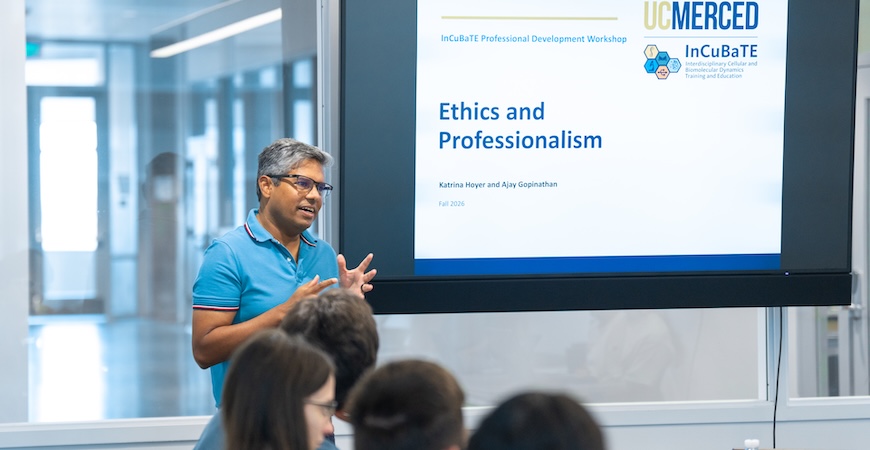
The program begins with a summer bridge experience that introduces trainees to the campus research community and helps the cohort develop connections before the academic year begins. During the first year, students complete research rotations and hands-on modules in cell and tissue culturing, imaging and spectroscopy, and computation and modeling. The curriculum also incorporates formal coursework on cutting edge techniques in molecular and cellular biotechnology and quantitative and computational methods, including emerging applications of artificial intelligence in biomedical research.
Professional development runs alongside the research training. Workshops cover individualized development plans, ethics and professionalism, rigor and reproducibility, data analysis and visualization, scientific writing, literature review, time management and preparation for oral and written examinations. Later activities emphasize career planning, public speaking and team science.
"The first year gives students a common foundation across experimental and computational approaches," LiWang said. "As they progress, the emphasis shifts toward applying those skills to their own research and preparing for the next stage of their careers."
InCuBaTE uses a multiple-mentor model. Trainees work with research advisors from complementary disciplines and receive guidance from an InCuBaTE leadership team mentor who is not their dissertation advisor.
Career preparation is tailored through each student's individualized development plan. Trainees can pursue experiences connected to biomedical industry and entrepreneurship, science communication and teaching. The program will connect students with UC and regional biotechnology networks, offer opportunities for community and K-12 outreach, and help trainees understand how their research skills translate to careers across the biomedical workforce.
"Scientific ability is essential, and students also need experience planning projects, communicating their work and navigating a professional research community." Gopinathan said. "InCuBaTE is designed to develop the whole researcher."
The program is supported by contributions from participating programs and the Graduate Division. "By providing critical support for our doctoral students, this NIH InCuBaTEgrant ensures that UC Merced can continue preparing the next generation of biomedical research leaders," Vice Provost and Dean for Graduate Education Hrant Hratchiansaid. "Its impact will extend far beyond our campus through graduates who apply their expertise into careers that advance human health."
 Public Information Officer

