


UC Merced is deepening its investment in the fight against climate change, uniting scientific expertise across campus to help confront the effects of a changing planet.
Leading that effort is the Sierra Nevada Research Institute (SNRI), UC Merced's first Organized Research Unit, which has merged with the UC Merced Climate Institute to form the UC Merced Earth Institute, an organization dedicated to advancing research and sustainable solutions to the environmental and climate challenges facing communities and ecosystems.
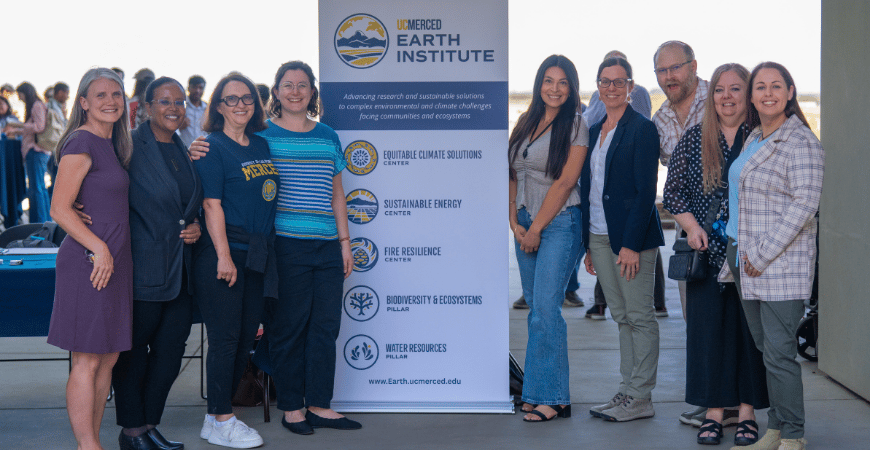
The institute marked the milestone Sept. 14 with a Fall Welcome Event celebrating SNRI's legacy and formally launching its new identity.
For nearly two decades, SNRI has fostered interdisciplinary research in ecology, earth and environmental sciences, social sciences and engineering, generating and sharing knowledge to sustain natural resources and promote social health and well-being in the San Joaquin Valley, the Sierra Nevada region and beyond. That work helped build UC Merced into a Carnegie R1 research institution, and the event recognized the researchers, students and community partners whose contributions made that designation possible.
Faculty Director Asmeret Asefaw Berhe and Executive Director Molly Stephens lead the newly combined institute, which continues SNRI's research strengths in hydrology, environmental contamination, sustainable land management, sustainable agriculture, and ecology and biodiversity. The Earth Institute builds on that foundation with five specialized focus areas tackling environmental problems intensified by climate and environmental change.
The Equitable Climate Solutions Center, led by Professor Rebecca Ryals, addresses challenges at the intersection of human well-being, the natural environment and climate justice. The Fire Resilience Center, led by Professor Safeeq Khan, advances the science, partnerships and solutions needed to help people and ecosystems adapt to a fire-altered world. And the Sustainable Energy Center, led by Professor Abel Chuang, supports the transition from conventional energy sources to renewable, efficient and low-cost energy systems, tackling the engineering and systems-level challenges of integrating renewables into the broader energy landscape. Two faculty-led research pillars further anchor the institute's structure: Water Resources and Biodiversity and Ecosystems, both of which build directly on SNRI's historic core research areas.
"By bringing our climate and environmental science research together, we're developing a more unified approach to some of the most pressing challenges of our time," Berhe said. "We are even better positioned to deliver the interdisciplinary, community-engaged solutions that the Central Valley and the world urgently need."
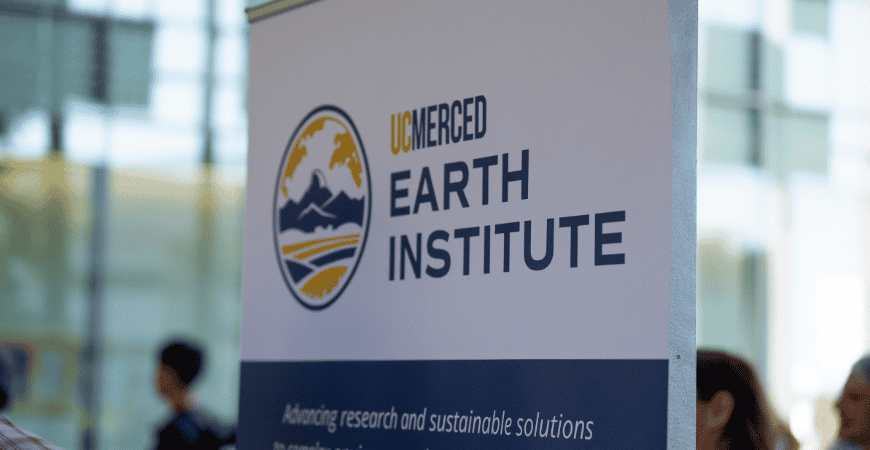
The new Earth Institute logo, featuring the famous rock formation Half Dome, nods to SNRI's role in UC Merced's founding. The group that would become SNRI was written into the university's original 1997 academic plan and soon began working with resource managers at Yosemite National Park, a partnership that brought the Yosemite Field Station in Wawona to UC Merced and established ties with Yosemite and Kings Canyon national parks. Those connections set the fledgling university apart from other UC campuses and universities nationwide.
In the years since, SNRI has used California's critical landscapes, from the Sierra Nevada through the Central Valley's agricultural lands and out to the sea, as a laboratory for research that speaks to global issues and helped shape UC Merced's growth as a research university. The evolution into the UC Merced Earth Institute marks the university's next phase in confronting the challenges posed by climate change.
As part of its expanded focus on climate issues and outreach, the Earth Institute continues its Distinguished Climate Speaker Series this fall, with a talk by Jonathan Foley on Oct. 26 at 3 p.m. in the Dr. Vikram and Priya Lakireddy Grand Ballroom in the UC Merced Conference Center. Foley, a world-leading environmental scientist and an expert in food systems and sustainability, ranks among the most-cited climate researchers in the world and will bring a message of science-based hope for meeting the challenges ahead.
More information about the Earth Institute's work, history and opportunities, along with RSVPs for upcoming events, is available at earth.ucmerced.edu.
 Public Information Officer

