


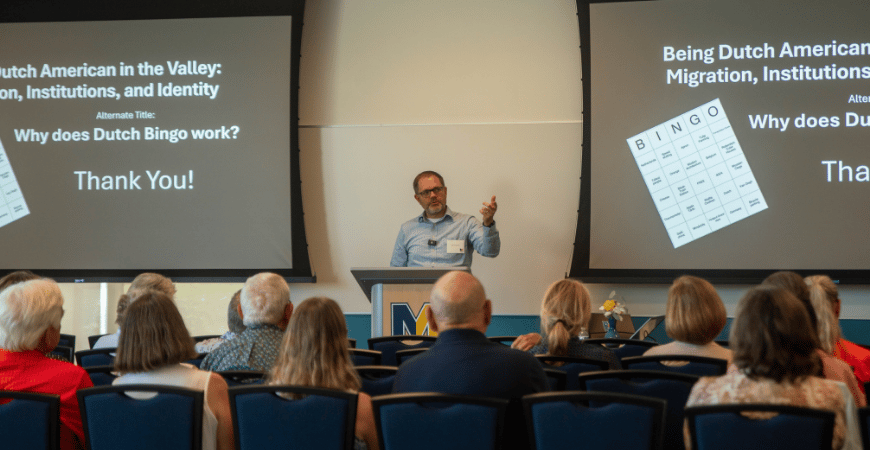
David Zwart hadn't even finished introducing himself as the keynote speaker for "The Dutch -American Story in the San Joaquin Valley" at the UC Merced event on July 14 before he'd found a connection in the audience.
"Any connections?" the historian and associate professor at Grand Valley State University asked, rattling off the years he'd spent teaching in nearby Visalia in the late 1990s. An audience member called out a name he recognized. It's a parlor game Zwart calls "Dutch Bingo," a version of six degrees of separation that, among Dutch Americans, usually takes one or two.
The moment set the tone for "Communities of the Valley," a new lecture series made possible through a generous gift from longtime UC Merced supporter and former U.S. Rep. Tony Coelho, who hopes that the university continues serving as a bridge between the region's ethnic communities and higher education.
The series’ inaugural installment focused on the history of Dutch American settlement in the Central Valley, opening with a keynote from Zwart, a historian of Dutch migration, followed by a panel discussion with community members from throughout the region.
Zwart traced how the Dutch American population in the Valley grew from failed 19th-century farming colonies into one of the region's most enduring immigrant communities, as families who had first settled in the Midwest later relocated to the Valley in search of land and religious community.
That migration accelerated in the early 20th century as Dutch settlers in Hanford, Ripon and Modesto recruited relatives and acquaintances through Dutch-language newspapers. Zwart cited a 1905 advertisement placed by early Modesto settler Egbert Stevens, who urged fellow Reformed families to join him because the community needed more members "in order to organize a congregation." The pattern repeated for decades, Zwart said, as word spread through family networks and church publications.
Within the Valley, Dutch settlement concentrated in Kings, San Joaquin and Stanislaus counties, anchored by Christian Reformed and Reformed Church congregations in Hanford and Ripon organized in the 1910s that went on to plant new congregations in Modesto, Escalon and Fresno through the 1960s. Zwart said that growth was sustained less by the size of the migration than by the density of institutions that bound Dutch American families together across generations. "Dutch American identity is more than windmills, wooden shoes and lawn ornaments," he said, noting that religious institutions gave the community a durability that outlasted its visible markers of ethnic heritage.
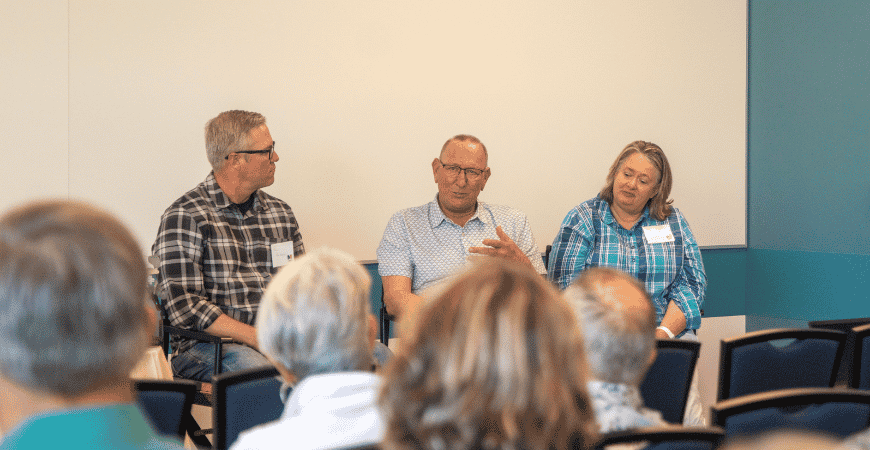
The program closed with a panel discussion bringing together three members of the Dutch American community with different ties to the Valley: Ann Pendleton, a high school teacher; Case Vyfhuizen, a Merced dairy farmer; and Pastor Joel Renkema of Visalia Christian Reformed Church. Their conversation, moderated by Professor Nathan Monroe, touched on faith, agriculture, education and intermarriage, reflecting the range of ways Dutch heritage continues to shape civic and economic life across the region.
Pendleton, who has taught at Ripon High School for years, noted the town's Dutch character has thinned as its population has grown from roughly 2,500 residents to more than 16,000, even as the families who remain have largely preserved their traditions. "The percentage is changing, but I think the values are staying the same," she said.
Vyfhuizen, who immigrated from the Netherlands in 1982 and settled in the Valley to farm, pointed to his own family as an example of that shift. Two of his children married partners of Portuguese descent, and a third married someone of Irish background, he said. Though a departure from the tight Dutch social circles of earlier generations, he noted that church life has held steady. "You teach your kids, bring them to church, they grow up in it, and you hope they find their own way," he said. "We've been blessed with that."
Renkema drew on a line from the Psalms to describe the instinct that shaped the community's early institutions. "How can we sing the songs of the Lord in a foreign land?" That question, he said, drove Dutch immigrants to build the churches and schools that still anchor the community today.
A Gift Rooted in the Valley
The Communities of the Valley series was organized by Monroe, the Tony Coelho Endowed Chair of Public Policy and founding director of UC Merced's Center for Analytic Political Engagement. Monroe said Coelho, a former Valley congressman and a lead author of the Americans with Disabilities Act, has long described his Portuguese heritage and dairy-farming upbringing as central to his own story.
"He left the Valley but never left it behind," Monroe said, describing the series as an effort to advance Coelho’s vision for UC Merced to serve as "a doorway delivering on the promise of being a university for the Valley, for everybody, in different ways."
Vice Chancellor for External Relations Ed Klotzbier, who was on hand to welcome the community in attendance, credited Coelho's gift with making the series possible. "His support reflects a belief that is core to who we are at UC Merced," Klotzbier said, "that the stories of this region matter, that the people of the Valley matter, and that understanding our shared history is essential to building a strong future."
Bryn Forhan, who spent many years on Coelho's legislative staff, attended the program and said it reflected the vision her former boss had held for the university since its founding: a place where the Valley's many communities could see their histories taken seriously. "There's a story for everyone here," she said.
Monroe said the event is the first of several planned under the series, which will next focus on the Hmong and Punjabi Sikh communities, two other groups with deep and long-standing ties to the Valley's agricultural, civic and institutional life, in future installments.
 Public Information Officer

