


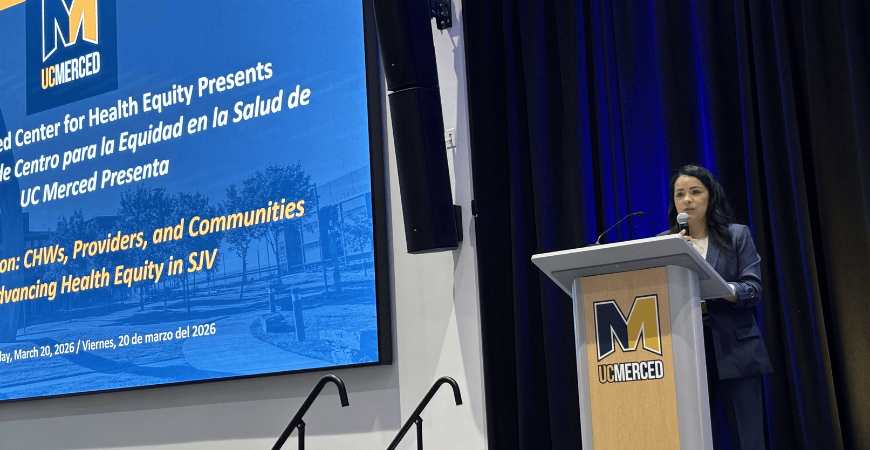
On March 20, UC Merced's Center for Health Equity brought together researchers, regional health partners and community members to share findings from a study on how community health workers are transforming patient care across the San Joaquin Valley.
"This has been a long-term vision for myself and many other individuals: to work community partners into the research process to address the needs of our region," said Dr. Rosa Manzo, principal investigator and center director. "Trust in Action: Community Health Workers, Providers and Communities Advancing Health Equity in San Joaquin Valley" event speakers shared metrics and qualitative data from the center's study on the role of community health workers, also known as promotoras, in building and sustaining trust between patients and providers.
Professor Deborah Wiebe, director of UC Merced's Health Sciences Research Institute, underscored why locally grounded research is needed in the Valley and how its absence has hampered efforts to address health disparities.
"It's very frustrating when you look at health survey data or health information and see an asterisk next to San Joaquin County and the San Joaquin Valley region because no data are available," Wiebe said. "Without that, you can't make evidence-based solutions. You can't make good policy decisions, and it really impairs your ability to advocate at a much broader level."
She added that deeper systematic changes need to be homegrown. "In order to have a good understanding and effective interventions that work in the San Joaquin Valley, it has to start in the San Joaquin Valley. And that's what this partnership is all about."
Research Findings
The study drew on interviews and focus groups conducted from March through July 2024 with 33 health professionals and 39 community health workers (CHW) across three health centers serving eight regional counties. A subsequent community health survey, conducted from July through October 2025, collected 403 responses from patients across partner sites, surpassing the original goal of 100 per site.
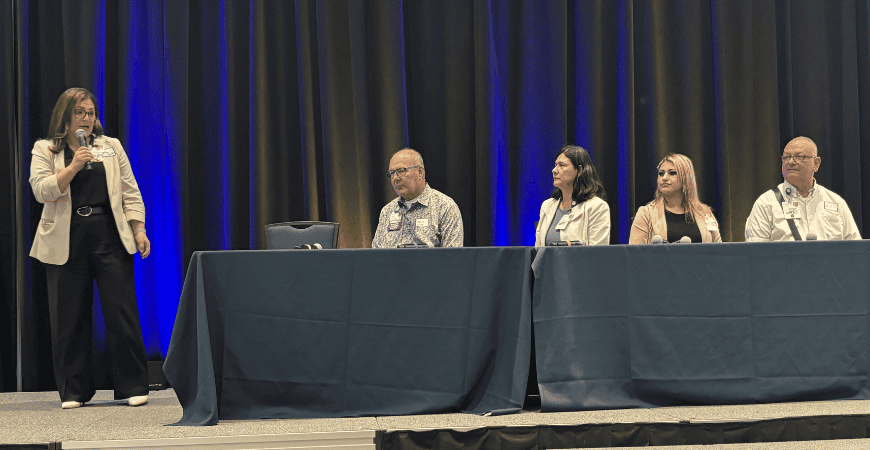
The three health partner sites — Camarena Health, Golden Valley Health Centers and Kaweah Health — shared their findings, offering a ground-level view of how trust play out across the Valley's diverse patient populations and care settings.
The patient population surveyed was predominantly Hispanic/Latino and Asian, including a significant Hmong-speaking community, with an average age of 43. Nearly a third of respondents had a high school education or less, and approximately 30% reported annual household income below $30,000. Nearly three-quarters of patients reported strong trust in their providers. Focus group data identified power dynamics in the exam room, communication and emotional safety and cultural respect and competence as the key factors shaping that trust.
One particularly notable finding was that nearly 75% of survey participants scored in the "inadequate" or "marginal" categories on health literacy assessments. Presenters said this directly affects trust, as the provider-patient relationship suffers when patients cannot easily understand the information they are given.
Digital access also emerged as a barrier. While about 77% of participants had access to a smartphone, reliable internet connectivity and comfort with health platforms, like MyChart, remained significant challenges, indicating a gap between device ownership and the ability to meaningfully engage with digital-health tools.
The Role of Community Health Workers
One of the most actionable findings from the study involves the reach and impact of CHWs. Despite CHWs' demonstrated effectiveness as patient advocates and cultural liaisons, only about one in four survey participants reported having worked with one. Among those who had, trust scores were notably higher.
The research identified CHWs as uniquely positioned to build patient-provider trust by validating patients' emotions, clarifying medical information and guiding individuals through complex care pathways. Providers described CHWs as cultural bridges and educators capable of reinforcing clinical messages and helping normalize routine healthcare engagement in communities that have historically been weary or suspicious of the healthcare system.
One CHW shared, "Even though physicians usually have some sort of medical Spanish training, it can be difficult to accurately interpret symptoms and feelings being described. We bridge that gap."
Based on the findings, the Center for Health Equity put forward seven recommendations for health systems, policymakers and funders, including:
· Investing in CHW-led care navigation
· Expanding state-level CHW certification and reimbursement pathways,
· Improving access to interpreters
Building clinical environments that center emotional and cultural safety.
The conference featured a keynote address by UC Merced Continuing Spanish Lecturer Yolanda Pineda-Vargas, whose work at the university reflects a deep commitment to connecting academic learning with community engagement.
The conference also showcased the contributions of UC Merced undergraduate research assistants, who presented posters on their work supporting the study, highlighting the project's commitment to training the next generation of community-engaged researchers.
Funding provided by Genentech, a member of the Roche group, supported the Center for Health Equity’s research and the conference.
 Public Information Officer

