


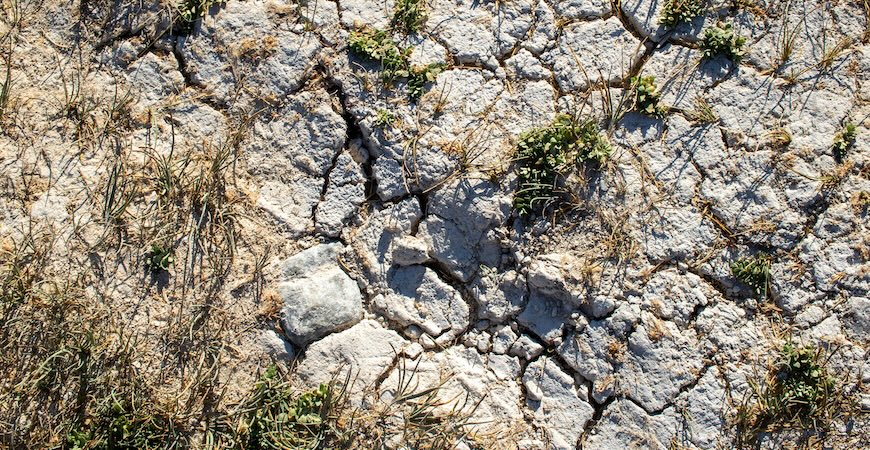
After a couple of years of sufficient water, much of California is showing "abnormally dry" conditions in spring 2026, according to the state drought monitor.
And as climate change adds more swings between wet and dry conditions, researchers are working on ways to better identify, predict and manage drought.
Toward that end, a UC Merced team contributed a chapter on "Artificial Intelligence for Multiscale Drought Modeling and Decision Making," in the new book "Global Drought and Sustainability."
The book was published by Elsevier, a global academic publishing company, and brings together leading researchers from around the world to examine drought as an increasingly urgent global challenge. "Global Drought and Sustainability" explores the connection between drought and climate change and outlines science-based solutions to improve water resource management, agricultural sustainability and ecosystem resilience.
The 14-chapter book features contributions from more than 40 authors representing over 15 institutions across at least 10 countries. It highlights emerging approaches such as advanced drought forecasting and the use of artificial intelligence to better predict and respond to changing environmental conditions.
UC Merced's contribution, written by project scientist Abid Sarwar, postdoctoral scholar Rui Gao and professors Safeeq Khan, John Abatzoglou, Josué Medellín-Azuara and Joshua Viers, explains how AI and machine learning tools can combine historical climate records, current observations, satellite imagery and sensor data to assess and forecast drought.
"Drought is becoming harder to manage because conditions can change quickly across farms, watersheds and regions," Sarwar said. "Our chapter shows how artificial intelligence can help connect satellite observations, field sensors, climate data and physical water processes so decision-makers have earlier and more reliable information. The goal is not to replace human expertise, but to strengthen it with tools that are better suited for a changing climate."
These tools are becoming increasingly important as climate change brings sharper swings between heavy storms and severe drought. Those shifts affect public health,local economies, agriculture, ecosystems and water supplies.
This year, for example, California had a fairly healthy snowpack, which supplies the state with water as it melts in the warmer months. But a March heat wave melted much of it weeks earlier than usual.
According to the Public Policy Institute of California, more than 5 million acre-feet of water stored as snow was lost in one month. And most of that water was not captured as runoff in reservoirs. Some went into groundwater, some into soil and much simply evaporated.
Multiple storms that moved through the state in April improved the outlook slightly, but the paltry remaining snowpack is now melting away and won't add much to summer supplies, the PPIC said.
Forecasting drought is more difficult in areas of the world that don't have the same level of monitoring California does. The UC Merced team pointed out that using AI can be a more scalable way to complement existing drought monitoring, especially in regions with limited ground observations, when used with physics-based understanding of water systems.
Advances in physical modeling, data science and sensing technologies have already transformed agricultural drought modeling and decision-making, the researchers wrote. Networks of soil-moisture sensors and weather stations now provide data to machine learning algorithms that optimize irrigation schedules and identify early signs of crop stress. Satellite and remote sensors monitor temperatures, soil conditions and vegetation health across large areas of land.
Earlier and more reliable drought information can help those living in affected areas to protect farms, save water and prepare communities before problems worsen.
 Public Information Officer

