


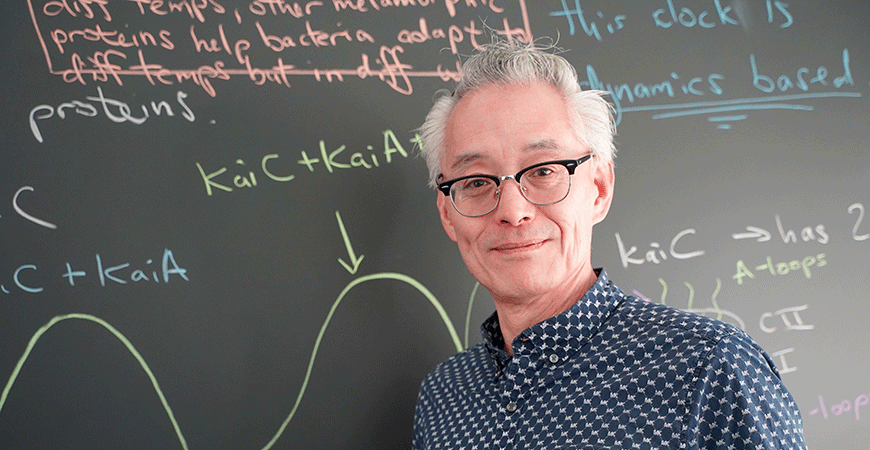
Biochemistry Professor Andy LiWang has spent much of his career studying how life keeps time. His work on the circadian clock of cyanobacteria — tiny, ancient organisms that share the planet with us — has shed light on one of biology’s most elegant systems.
But his newest research project, supported by a prestigious $1.2 million grant from the William M. Keck Foundation, pushes that inquiry into bold, uncharted territory.
LiWang and his collaborators believe they may have uncovered a universal mechanism that explains how bacteria, and potentially many other organisms, adapt to changes in temperature. At the heart of this idea is a rare, mysterious category of proteins known as metamorphic proteins — shape‑shifters that can flip between two distinct structures, each with its own function.
If their hypothesis holds, the discovery could open the door to a new scientific field and help rewrite long‑standing assumptions about how proteins work.
The project began with a puzzle: Cyanobacteria, like all organisms with a circadian clock, must generate an accurate biochemical representation of time regardless of environmental conditions.
“Circadian clocks have to tell time at a constant pace,” LiWang explained. “They can’t run faster on warm days and slower on cold days.”
Mechanical clocks once struggled with this same problem. Before engineers learned to combine metals with different rates of thermal expansion, a clock’s ticking could drift significantly depending on the weather.
Nature’s solution, LiWang suspected, might be just as clever.
His lab discovered that one of the core clock proteins in cyanobacteria, known as KaiB, behaves in an astonishing way: It switches between two folds — an active shape and an inactive one. At higher temperatures, the protein shifts toward its inactive form, counteracting the natural tendency of reactions to speed up. At lower temperatures, it leans toward its active form, helping the clock maintain steady function.
This temperature-dependent shape shifting, LiWang realized, might not be unique in helping organisms adapt to fluctuating environments.
Only a handful of metamorphic proteins have ever been identified, and nearly all were discovered by accident. Historically, researchers lacked a reliable method to determine whether a protein could adopt multiple folds. Each known metamorphic protein seemed to have a different trigger — a change in pH, salt concentration or binding partner.
But LiWang’s team noticed something all these proteins shared: One of their folds is inherently more stable at high temperatures, the other at low temperatures. That insight led to a provocative hypothesis — a single, universal trigger for all metamorphic proteins.
Temperature.
If true, this offers a way to detect shape‑shifting proteins at scale for the first time.
The Keck-funded project aims to put that idea to the test. Working with collaborators at Caltech and the University of Maryland, the team is exposing the E. coli proteome to different temperatures, partially digesting it with enzymes, and analyzing the cut patterns using mass spectrometry. Proteins that change shape at different temperatures will show different digestion profiles.
Those candidates will then undergo targeted structural analysis — particularly through nuclear magnetic resonance spectroscopy, the gold standard for confirming metamorphosis.
Once the team identifies bona fide metamorphic proteins, it will genetically modify E. coli so that those proteins can no longer change shape. If the bacteria struggle to survive temperature swings compared to unmodified strains, that would strongly support the idea that those metamorphic proteins help E. coli adapt to thermally changing environments.
“It’s definitely high‑risk, high‑reward,” LiWang said. “It could open a whole new field — or we could find out we were wrong. But that’s science.”
If metamorphic proteins turn out to be widespread sensors of temperature in living systems, the implications ripple across biology.
Plants, for instance, cannot move to escape heat or cold. If metamorphic proteins help them survive fluctuating climates, researchers might someday design crops better suited for warming environments or for agriculture in new regions.
The same could apply to fungi, insects and other cold‑blooded organisms that rely on external temperatures.
Biotechnology, too, could benefit. Industrial microbes could be engineered for more efficient fermentation, pharmaceutical production or biofuel synthesis under changing conditions.
Even the search for new ways to counter invasive species or pathogenic bacteria could benefit.
“If temperature truly is the universal trigger, then metamorphic proteins could be far more common than we ever imagined,” LiWang said.
The project is also a story of scientific perseverance. LiWang first proposed the concept of a “metamorphome” — the complete set of metamorphic proteins in an organism — in a Keck proposal back in 2016. It was rejected. At the time, the idea lacked the evidence and clarity that now underpin the team’s strategy, he said.
The second time turned out to be the charm. Last year, LiWang, a member of the Department of Chemistry and Biochemistry, the NSF-funded CREST Center for Cellular and Biomolecular Machines and the Health Sciences Research Institute, brought new data and a stronger vision: a way to systematically uncover an entire class of proteins long overlooked because their shape‑shifting nature was nearly impossible to detect.
“Now we have a targeted approach,” he said. “Before, it was like waiting for someone to stumble on one by accident.”
Whether the metamorphome proves to be vast or surprisingly sparse, the work promises to deepen scientific understanding of how life adapts, survives and keeps its internal rhythms steady against the changing world.
And if LiWang is right, a quiet revolution in protein science may already be taking shape.
Lorena Anderson

Senior Writer and Public Information Representative
Office: (209) 228-4406
Mobile: (209) 201-6255


