


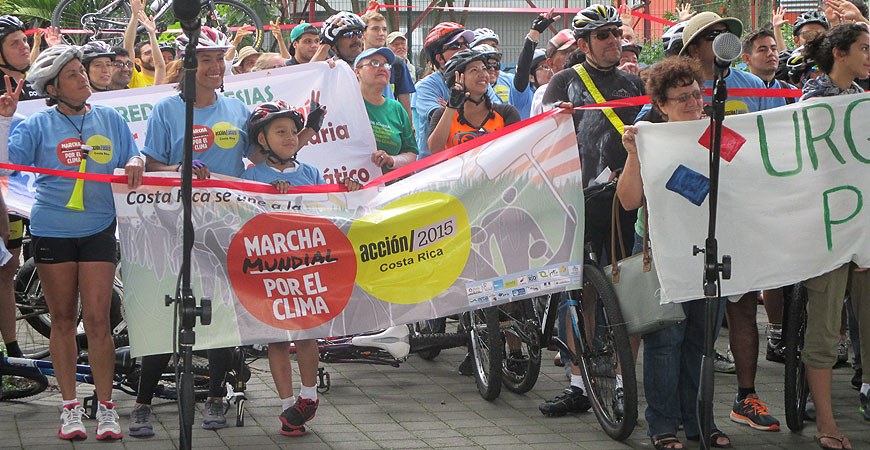
Climate change is a global crisis and the search for solutions is increasingly technological. A new, 700-page volume edited by a UC Merced sociologist demonstrates that moving people, institutions and communities to act may be just as consequential.
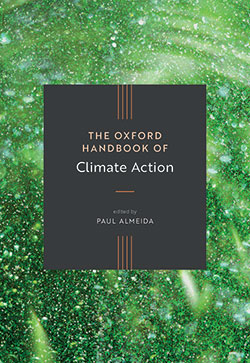
Sociology and environmental systems Professor Paul Almeida has edited “The Oxford Handbook of Climate Action,” a fundamental reference work that gathers 39 chapters from over 60 top environmental and climate scholars around the world.
Published by Oxford University Press, the book serves as a starting point for readers who want to understand how climate action happens and the forms it takes, whether they're picking up the handbook in Merced or Nairobi.
That worldwide reach is by design. Earlier climate handbooks were written during an prior wave of climate action in the 2000s and 2010s. This current collection updates climate action into the second quarter of the 21st century. All the chapters were written in the last two years and grapple with today's political context, such as climate change denialism, along with new technologies such as climate capture and storage.
 What sets the handbook apart, Almeida said, is its emphasis on combining human-based solutions with emerging climate technologies rather than purely technical ones. Climate change won't be solved by clean energy alone, he said.
"We need to comprehend the social and economic structures that sustain a fossil-fuel-based society and the human-based incentives necessary to transition to a green economy," Almeida said.
“How do the new generation of renewable energy systems and climate technologies benefit frontline communities without reproducing existing systems of stratification and inequality? What kinds of social safety nets can we envision by working with communities and workers in the largest societal transformation since the Industrial Revolution?”
The handbook is organized around three themes:
-
The major theoretical perspectives driving the field of climate action
-
Institutional strategies such as renewable energy, reforestation, carbon capture and climate action planning
-
Grassroots action such as mobilized social movements
A fourth layer of regional chapters spans nearly every part of the globe, from Asia and Africa to Latin America. The contributing scholars affiliate with an impressive array of international institutions, initiatives and organizations including:
-
Middle East Council on Global Affairs (Qatar)
-
Asian Institute of Technology (Thailand)
-
LDC Universities’ Consortium on Climate Change (Bangladesh/Uganda)
-
Centre for Climate and Resilience Research (Chile)
-
Institute of Environmental Science and Technology (Spain)
-
South Korean Ministry of Climate, Energy and Environment (South Korea)
-
Indian Council of Social Sciences Research (India)
-
Heidelberg University Center for the Environment (Germany)
-
OGCI China Climate Investments (China)
-
Global Carbon Capture and Storage Institute (Australia)
Among the chapters Almeida points to is one on 350.org, the organization that helped build the modern global climate movement years before Greta Thunberg and the Fridays for Future youth-based protests. The chapter is written by three of the group's founders, who organized as students of author and activist Bill McKibben at Vermont's Middlebury College in the mid-2000s before taking their work international.
Almeida co-authored the introductory chapter with current and former UC Merced graduate students. The chapter classifies how different forms of climate change threats induce climate action.
The handbook grew out of Almeida's own climate-based research. After finishing a solo book on climate action, “Climate Change and Civic Engagement,” he guided the Oxford collective volume through several rounds of review. The solo book, also published this year, focuses more on the United States and California — with a chapter dedicated to the San Joaquin Valley — and is grounded in his scholarly background of implementing in-person representative surveys with community partners and the UC Merced Community and Labor Center on basic climate needs in thousands of households in disinvested census tracts throughout the region.
For UC Merced, the timing of the books fit well with a broader push. In 2022, California Assembly Bill 179 directed about $18 million toward climate action research at the university, with roughly $9 million awarded to UC Merced faculty through competitive grants.
The university sits in the heart of the San Joaquin Valley, a region marked by extreme heat, a large outdoor workforce and some of the state's least developed climate action planning — a combination Almeida argues makes it a priority for the kind of social science expertise and research the handbook collects.
Colleagues have taken note. "Almeida's edited volume highlights why the social sciences are indispensable for addressing planetary warming, from understanding human behavior to increasing public participation in climate action," said Gillian Wilson, UC Merced vice chancellor for research, innovation and economic development.
Leo Arriola, dean of the School of Social Sciences, Humanities and Arts, called the handbook "an essential public good.”
"It reminds us that technological innovation alone is not enough to address the climate crises already felt around the world," Arriola said. "Almeida's handbook provides insights to understanding how people can work together and with their institutions to bring about lasting change."
 Public Information Officer

