


UC Merced has established its identity as a world-class research university that welcomes learners who historically have been left out of higher education. Nearly three-quarters of its undergraduates are first-generation college students.
This distinction put the university in welcome company when it co-hosted one of a handful of institutes held nationwide that trained instructors on how to teach reading and writing effectively at access-oriented institutions: community colleges and open-enrollment universities that educate underserved students.
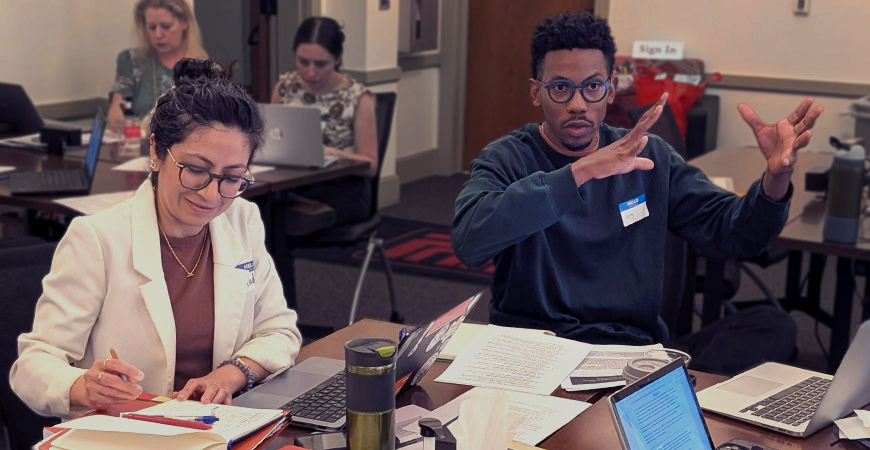
The Institute on Reading and Writing Pedagogy (the methods and practice of teaching) held its California course June 8–12 at Fresno City College, Merced College and UC Merced. Estee Beck, director of UC Merced’s Karen Merritt Writing Program, co-designed and ran the course with Sean Epstein-Corbin, co-chair and professor of Merced College’s English Department, and Mario Giron, English instructor at Fresno City College.
The institute project, funded by the Mellon Foundation for humanities and arts, is presented by the Modern Language Association. Since 2019, MLA has used the institutes to train more than 300 graduate students and early-career instructors across the nation. Thirteen people were chosen to attend the California institute.
The focus of the training was practical and urgent: In an era of artificial intelligence tools, shortened attention spans, and students who came of age swiping through social media, how do instructors teach people to read and write with depth and rigor?
Genevieve Egbunno, a UC Merced sixth-year graduate student in interdisciplinary humanities, said the institute was transformative. Egbunno, an anthropology teaching assistant, learned new ways to help her undergraduates engage deeply with heavy reading loads and express ideas clearly in writing.
For Kara Ayik, a lecturer in the Merritt Writing Program, the institute was a recalibration in a long career.
Ayik, who has taught writing for decades, said the landscape has shifted dramatically. Students today often struggle to sustain focus on longer texts, she said. The institute's emphasis on designing instruction that meets students where they are without lowering expectations resonated with her core beliefs.
"I want to keep the standards high but make it reachable," Ayik said.
Robbie Hill, an English teacher in his third year as an adjunct instructor at Clovis Community College, appreciated discussions about artificial intelligence. He said students often use AI to avoid their struggles with a subject. Hill wants his students to "sit in that curiosity and discovery area" where getting stuck can sharpen critical thinking.
“Access-oriented institutions are the front line in higher education. Training faculty to design deep reading and writing activities is some of the most important work we can do in the age of AI,” Beck said. “This is what this institute is about. It helps teachers build critical reading and writing skills for first-generation students.”
Beck said co-facilitating with Epstein-Corbin and Giron made the work even richer, drawing on their experience in community colleges and university classrooms. She hoped this was the first of many institutes offered in the Central Valley to create a network of educators who work at the intersection of reading and writing.
 Public Information Officer

