


Many organizations claim sustainability is baked into their DNA. Nowhere is that truer than at UC Merced, where the approach to sustainability, climate action and ecological conservation is part of everything from the buildings on campus to the research in its labs to the way it conducts business.
Recently, the university and the U.S. Green Building Council Central California hosted a tour showcasing the university's leadership in sustainable design and green business practices throughout the Central Valley.
UC Merced is the only university in the United States with 100% of its permanent, public-facing buildings certified under the USGBC's Leadership in Energy and Environmental Design (LEED) program; most of them achieved the platinum ranking. It is also the first public research university in the country to achieve carbon neutrality, which means any greenhouse gases released into the atmosphere are balanced with at least an equal amount removed or offset.
"USGBC Central California brings together our community through green project tours in the region," said Laura Gromis, executive director of USGBC Central California."UC Merced is a sustainability beacon in the San Joaquin Valley that demonstrates how to implement and advance sustainability in the built environment and beyond. It's a perfect place to learn about implementing sustainability in the built environment through a real-world example."
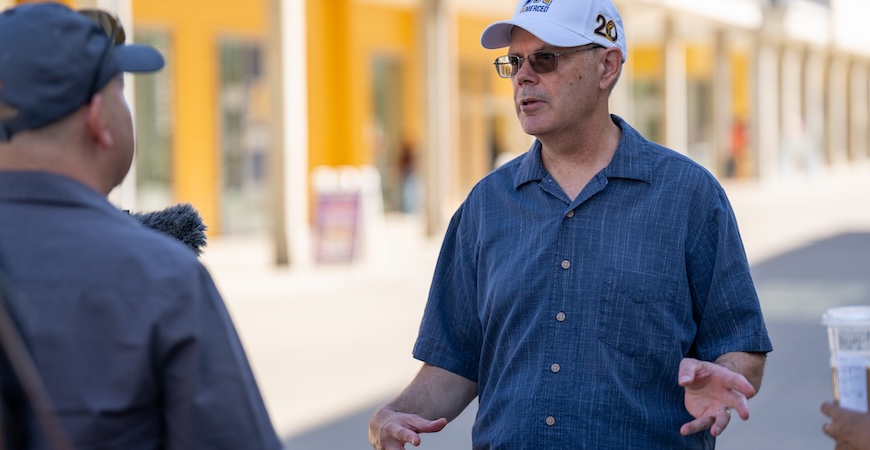
UC Merced Sustainability Director Daryl Pierson and Assistant Director Sawani Poornima Goonatilleke Nallani hosted the tour for local builders, environmentalists and contractors, showing them what the campus is doing to protect the planet's precious resources. They are building on a strong history the university has had as a leader in sustainable practices.
It takes more than just responsible use of resources. Sustainability takes into account economic and social impacts as well as environmental concerns, Nallani said.
"In the long term, companies save much more money by putting solar panels on and using wind power," she said.
That can be a challenge when working at a public facility where the bottom line is always a concern, said Jim Brugger, the retired director of campus engineering services.
"It makes buildings much more expensive, though it pays for itself over time," he said. Though the campus is only 21 years old, technology has already evolved. The new Medical Education Building, set to open next year, is the campus's first all-electric building.
"It's not connected to the central plant at all," Brugger said.
The goal from the beginning was to make the campus "as efficient and sustainable as possible," Brugger said. He showed attendees some of the architectural aspects that contribute to that, including shades outside of large windows that keep them from getting too hot and even small vinyl squares adhered to the inside to deter birds from running into them.
UC Merced's sustainability efforts may start with its buildings, but they certainly don't end there.
The tour stopped at the Pavilion, where Director of Residential Dining Anthony Pangelina described measures his team has taken to make the operation more sustainable. That includes cooking from scratch, using locally produced food and working with local farmers to provide students with fresh, minimally processed meals.
"Our local spend is up and our sustainability spend is way up," Pangelina said.
The tour then stopped by the Sustainability office, where interns helped attendees play a trivia game. Sample question: What material can be recycled an infinite amountof times? Answer: Glass.
Brugger led the way to the Leo and Dottie Kolligian Library, where another display highlighted the university's Living Lab, which offers students, faculty and staff the opportunity to boost efforts in achieving climate goals.
The library was the university's first building, and the first to be LEED-certified, which required more than just proving the construction was sustainable.
"Things like office supplies, toner and ink - I had to go to each department and get their procurement records," Brugger said.
After a tour of the Central Plant, the day ended with a presentation by Pierson and Nallani about what they are planning next. That includes working to make events zero waste and fully decarbonizing the university.
There are many challenges ahead, but the university is well-positioned to take them on, they said.
"That early direction really set the course for the accomplishments we've had," Pierson said. "That doesn't happen by accident."
 Public Information Officer

