


Should a scientist who sees signs of global catastrophe sound an early alarm or wait until more conclusive evidence is in? Does going public lead to swifter action or give naysayers more time to discredit the message?
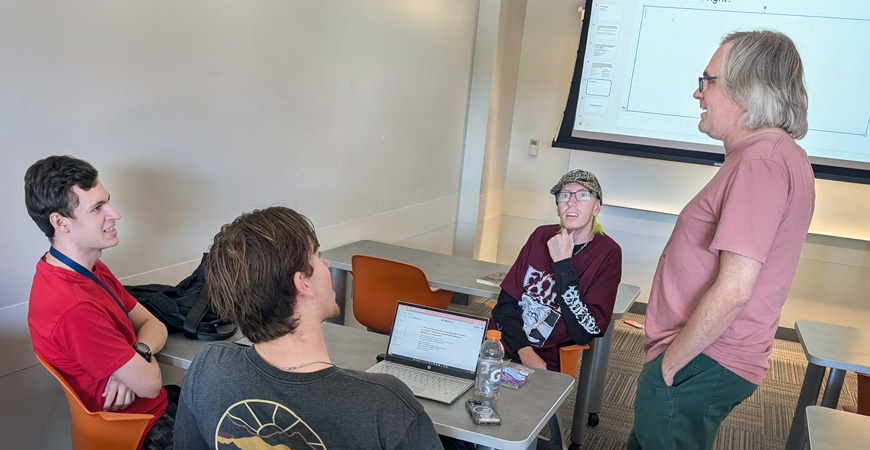
Students in Professor Dan Hicks’ course in science, technology and ethics discussed the pros and cons. Does sharing initial findings waste resources if the findings turn out to be flawed? If the scientist waits to come forward, could the crisis become too big, expensive and politically fraught to control?
One student argued that speaking out early is good because “even if you can’t answer unanswerable questions, you provide an area of focus. You encourage further studies.”
Another said if the scientist waited, “they would have more time to research it and then drop the bomb with all the information.”
And around it went.
In a world where artificial intelligence, climate change, epidemics and bioengineering compete for our attention and concern, the need for people who can weigh the technical and humanistic sides of an argument is crucial. UC Merced’s science, technology and ethics major, which debuted in fall 2025, addresses this need.
'In society, we have all of these challenges where science and technology are wrapped up in complex social, political and legal problems.'
Students who pursue the bachelor of science degree take courses that bridge the divide between philosophy and the sciences. Graduates can pursue careers ranging from policy advocate and compliance officer to patient advocate.
“In society, we have all of these challenges where science and technology are wrapped up in complex social, political and legal problems,” said Hicks, who led the major’s design. They noted that about two-thirds of the course requirements are in the humanities and social sciences. The remaining courses are in a STEM field the student chooses, such as data science, biology or public health.
“We’re bringing these two perspectives together,” said Hicks, who has taught philosophy and science policy at UC Merced since 2019.
The questions that opened this story are based on a real event: In June 1988, climatologist James Hansen testified to a Senate committee that Earth was, at that moment, warmer than at any time in measurable history. He warned that sunlight trapped by gases such as carbon dioxide — the greenhouse effect — was already strong enough to trigger unusually extreme weather.
It was a watershed moment; for the first time, an eminent climate scientist, in a highly public and politically potent forum, said he was certain the planet was heating up beyond natural variations. In the years and decades that followed, research confirmed Hansen’s projections of human-caused climate change. But in the late ’80s, his interpretation of the data “was kind of out on a limb,” as one contemporary climatologist put it.
Today, society is in a similar position with contentious issues such as artificial intelligence, vaccines, social media and (still) climate change. There is a powerful need for experts who can identify and communicate how emerging technologies and discoveries could affect people and the planet.
First-year student Dylan Carlton said he took Hicks’ ethics course because it combined his interests in technology and philosophy. The class has given him new insights into how the two intertwine.
“The idea that experimentally verifiable knowledge could replace parts of philosophy was a fascinating perspective,” Carlton said. “We explored what types of research should be prioritized, depending on complicated issues such as social consequences rather than simply academic advancement.”
Hicks brings to the course — and to the major — first-hand experience with complicated issues, thanks to a science fellowship that placed them in roles with the U.S. Environmental Protection Agency and the National Science Foundation. When students reviewed a case study about chemical safety, Hicks shared what they learned working with a team at the EPA.
“Philosophy isn’t you just sitting back and asking questions you find interesting,” Hicks said. “It is a skill set you can bring to many workplaces and apply to a lot of important questions.”
 Public Information Officer

