


One of the biggest hurdles facing local farmers is the rising cost of doing business.
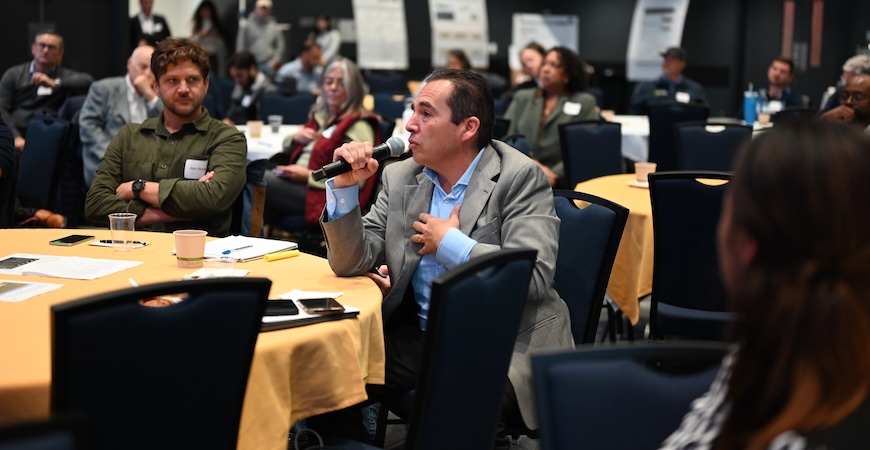
However, some innovative solutions are in the works, as highlighted at the Central Valley Rural Energy Systems Workshop at UC Merced in early December.
Hosted by the UC Merced Energy Center and the Sierra Nevada Research Institute, the all-day event brought together farming, industry, agency and research innovators to make new connections and identify new research directions.
The morning session helped bring the problems into clearer focus.
"Electricity prices are high, water is scarce, tariffs have disrupted historical business patterns," said Professor Sarah Kurtz, chair of the Electrical Engineering Department and director of the UC Merced Energy Center. "Electricity demand is increasing in a way we haven't been planning for, and interconnection queues are long."
"We're losing our rural communities and the way they used to pull together," said Cindy Lashbrook, owner of Riverdance Farms in Livingston. "Many small farmers are finding it too expensive to keep their operations going, with the costs of irrigation and electricity increasing and tariffs eating into profits.
"Irrigating costs us $24,000 per year," she said. "That wouldn't be so bad if farm prices weren't going down."
Water scarcity is also a major concern in California. As temperatures rise and the snowpack is depleted, more groundwater is being used. Civil and environmental engineering Professor Thomas Harmon likened it to a credit card - easy to overuse and difficult to repay.
Researchers in his laboratory are looking into ways to repurpose farmland that can lead to economic development, benefits for communities and wildlife, and ways to replenish groundwater systems.
"If we take the long view, we can take some of these challenges into major opportunities," Harmon said.
Several presentations focused on solutions to solar power's daytime and seasonal limitations. Hiro Iwanaga of the green energy company Talusag described how farmers could make fertilizer on-site at a lower cost by installing solar panels and Talusag's distributed ammonia system to produce green ammonia in sunny locations.
Some of the highest costs associated with both fertilizer and electricity come not from producing them, but from transporting them to where they need to go. So if there are ways to move production closer to where the products will be used, they can be more cost-effective.
Iwanaga said his company has lowered the cost of nitrogen fertilizer in western Kenya by more than 60 percent, and expects to increase deployments across the United States.
Though there are currently no plans to expand into California, it would make sense for farmers here, he said.
"You have a market with relatively expensive fertilizers and relatively cheap power if you can generate it," he said. "Those should fundamentally be the best markets for green ammonia."
Josh Bennett with Huwa Enterprises described a project that combines solar panels with cattle grazing. In addition to producing electricity, the system benefits the cows, providing shade relief from direct summer sun.
Huwa conducted a test of the system in Louisiana, and "the results were nothing short of phenomenal," Bennett said. "Shade is a benefit to cattle and farmers."
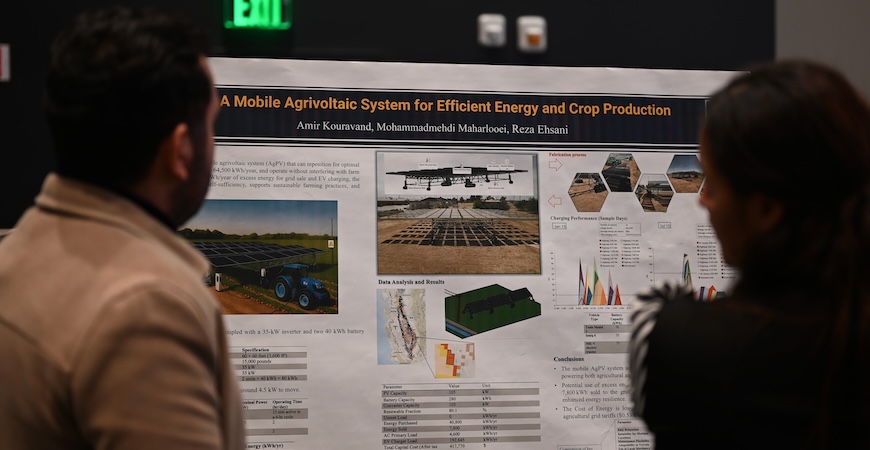
Other presentations included mobile, floating, or vertical fence solar. Vertical fencing has generated interest from farmers for strategic placement between rows of crops, according to Helge Biernath, CEO of Sunstall.
"The vertical design effectively sheds snow and dust, minimizing maintenance," he said.
Attendees tackled big-picture planning and policy issues in a panel discussion moderated by the California Energy Commission's Raja Ramesh. UC Merced electrical engineering Professor Eric Cheng also provoked a rethinking of the current alternating current (AC) based system, arguing for the cost savings, photovoltaic and grid integration capacity, and energy efficiency benefits of direct current (DC) based systems that can avoid AC/DC conversion inefficiencies and directly power today's DC-based devices.
"In the next 10 to 20 years, the market will be dominated by electric vehicles, robots and data centers," Cheng said. "It's a new era of power for the future."
UC Merced researchers look forward to being part of addressing the problems that farmers and rural communities are facing today. A summary of workshop presentations and information on how to engage can be found at https://bit.ly/4joYbKx.
 Public Information Officer

