


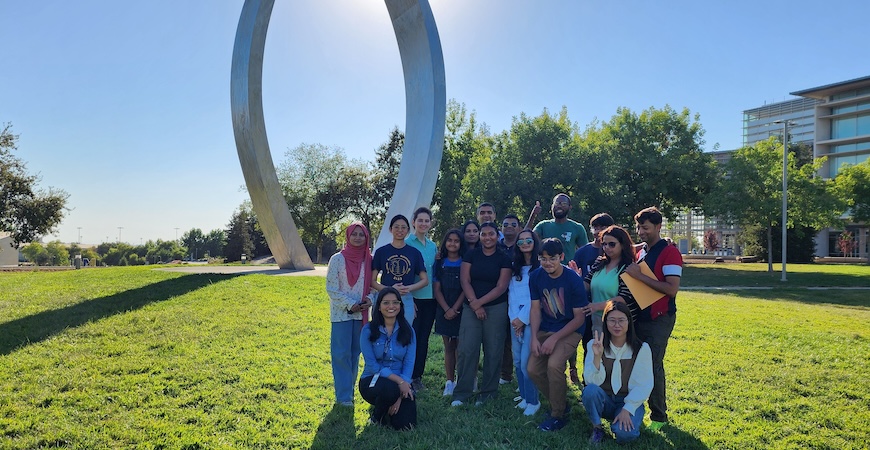
High school students have an extraordinary opportunity to explore software development through a summer internship program at UC Merced.
Computer science and engineering Professor Ahmed Arif started the High School Internship program in the Inclusive Interaction Lab in 2018 to give young minds early exposure to research.
"Each year, I personally mentor four high school interns, teaching them how to conduct research responsibly, uphold strong ethical standards and gain hands-on experience in building real-world software systems," Arif said.
After a pause during the COVID-19 pandemic, the program has returned and is now mostly virtual, which makes it more accessible to a wider group of students throughout Northern California.
Arif receives numerous applications each year, mainly from students in the Bay Area. He said he would like to see more applicants from the northern San Joaquin Valley.
Last year's cohort worked on a range of innovative projects involving gestural interaction, stress detection, personal assistants and emotion recognition.
"Their curiosity, creativity and dedication continue to inspire me every summer," Arif said. He designed the internship to help set students up for success, wherever their academic careers take them.
Anna-Maria Gueorguieva was one of the early participants. She graduated from UC Berkeley in 2023 with degrees in data science and legal studies, and is now pursuing a Ph.D. at the University of Washington.
Gueorguieva took part in the internship its first year, the summer before her senior year at Merced's El Capitan High School.
She worked on a project to design and build an interface on smartwatches that would understand Morse code.
"These tools were being used to test if Morse code could improve accessibility in touchscreen devices for people with impaired mobility," she said. "This was my first experience with research and working in a lab, and I was inspired by the idea that I could work with others to improve technology and society in ways that were previously unexplored.
"Participation in the Inclusive Interaction Lab helped shape my academic and professional experience up to today."
Advay Bajpai, a computer science and math major at UCLA, called his experience in the program "awesome."
"I learned a lot directly from Professor Arif and graduate students both in person and online," he said. "We had a small cohort, so it was possible to have one-on-one discussions with the mentors, which was great. I learned a lot about how research works at the collegiate level."
Hasini Manda, a junior at American High School in Fremont, took part in the internship last summer. Her research project involved interviewing people to explore how different populations perceive humanoid robots.
"Hearing their perspectives opened my eyes to the varied ways people think about emerging robotic technologies," she said. "Some participants approached humanoid robots with excitement, while others expressed caution or curiosity, which helped me see the broader social impact of robotics."
Manda said the program enabled her to explore research.
"Before this internship, I thought research was a straightforward process with clear, fixed steps," she said. "While structure is important, I quickly learned that real research requires flexibility and the ability to see both your subject and the people involved from multiple perspectives. … This experience inspired me to explore hardware-focused projects and think more deeply about how engineering and human interaction intersect."
She is now working on a haptics project with a graduate student mentor.
"The whole experience gave me invaluable knowledge about research and helped me grow as both a student and a collaborator," she said.
Jasamarbir Singh Arora, a senior at American High School in Fremont, said the program allowed him to create and design a research project from scratch.
"It's a great way to explore areas of research that the participants are interested in learning while exploring areas of computer science and human-computer interaction," he said.
Arora said it's a lot of work - the program runs for 12 weeks and requires roughly 20 hours per week - but by the end of it, he had learned how to structure a project, think critically from multiple perspectives and move from an idea to a complete, working solution.
"Professor Arif provided guidance throughout the process by explaining key concepts, giving valuable feedback, and helping me organize my research into a clear, actionable plan," he said.
Arif said while demanding, the internship is flexible and can be worked around a family vacation or other obligations.
"In research, you cannot schedule productivity," he said. "Sometimes you're in the mood to do it, and sometimes you're not in the mood. This is being human."
In addition to learning valuable research skills, the internship provides students the opportunity to see where their interests lie. Though it's a computer science program, multiple disciplines are involved.
"The processes are the same, regardless of the field you go into," Arif said. "This kind of gives them a clearer sense of where they want to go."
 Public Information Officer

