


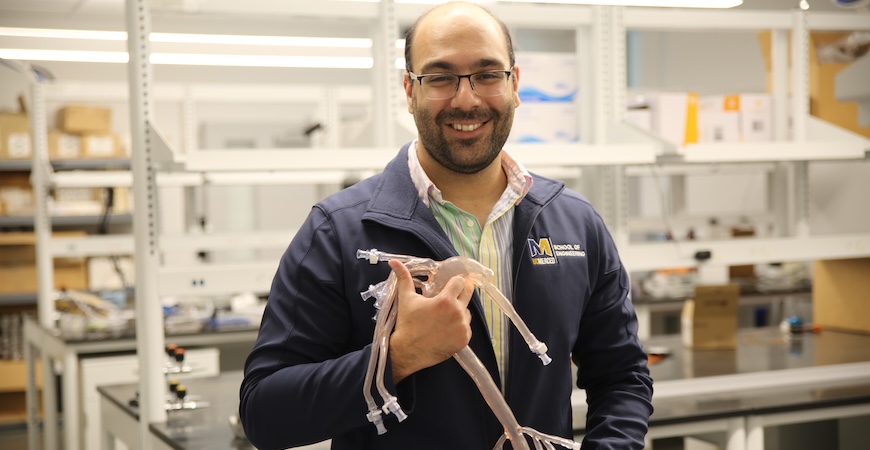
Left ventricular devices, or LVADs, are life saving for patients with advanced heart failure, a condition that affects more than 6 million Americans each year.
A UC Merced researcher has earned an American Heart Association Career Development Award to fund his work on improving how these mechanical pumps interact with the heart and body. It's the first time a faculty member from UC Merced has received one of these awards.
Bioengineering Professor and biofluid dynamicist Arian Aghilinejad's project, "A Fluid Dynamics Approach to the Development of Next-Generation Left Ventricular Assist Devices," won the $231,000 award, which will support three years of research.
"While LVADs have significantly improved survival rates, many patients still experience serious complications, including blood clots, stroke and right-heart failure," Aghilinejad said. "My research focuses on understanding the underlying fluid dynamics that contribute to these complications. By achieving a better understanding of device operation, we aim to reduce risks and improve long-term outcomes for patients."
Aghilinejad will work with physician-scientists, including vascular and cardiac surgeons.
"This interdisciplinary approach helps bridge engineering innovation with real-world medical needs and supports the development of next-generation cardiovascular therapies," he said.
"This grant supports highly promising health care and academic professionals, in the early years of one's first professional appointment, to explore innovative questions or pilot studies that will provide preliminary data and training necessary to assure the applicant's future success as a research scientist," the Heart Association said in announcing its awards.
Aghilinejad is in his first year on the School of Engineering faculty. He said his research aims to develop engineering-driven tools for diagnosing and monitoring cardiovascular disease, as well as improving therapeutic technologies. Prior to coming to UC Merced, Aghilinejad earned a Ph.D. from the University of Southern California and completed his postdoctoral training at the California Institute of Technology.
"This award is a tremendous recognition of Professor Aghilinejad’s creativity, technical expertise and potential for impact at the interface of engineering and medicine," said department chair Anand Bala Subramaniam. "His work exemplifies the kind of interdisciplinary, translational bioengineering we are building at UC Merced, where fundamental insights in fluid dynamics can lead to better technologies and improved outcomes for patients."
Aghilinejad said his work has been supported by a strong mentoring team that includes professors Arash Kheradvar from UC Irvine, Joel Spencer from UC Merced, Gregory Magee from New York University and Serge Kobsa from USC.
"I was drawn to UC Merced because of its dynamic and rapidly growing research environment, and the opportunity to contribute to a young campus that is building innovative programs at the intersection of engineering and medicine," he said. "A central part of my mission is to equip the next generation of engineers and scientists to translate mechanistic insights into real-world medical solutions."
 Public Information Officer

