


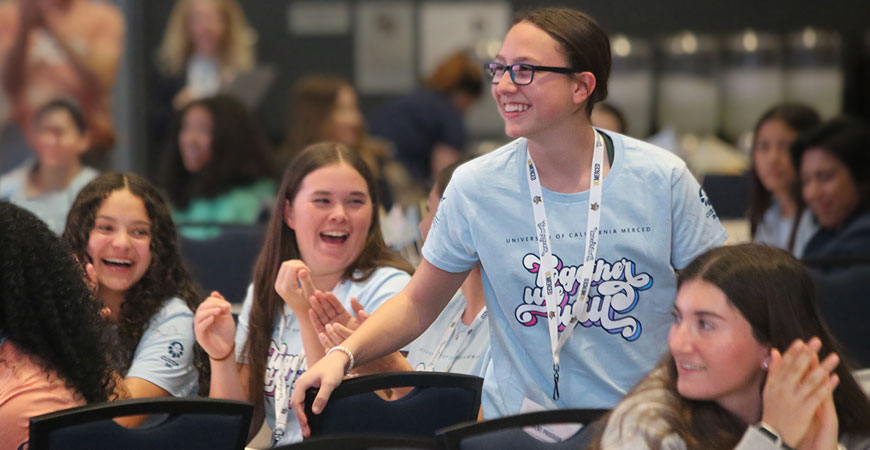
Victoria Garrick Browne, a nationwide advocate for mental health and self-care, had a simple message for a big room full of high school girls gathered for the Together We Will Sports Leadership Summit at UC Merced.
“Be where your feet are,” said Browne, a former NCAA Division I volleyball player whose messages of empowerment have attracted more than 2 million social media followers. “Many times, our feet are here while our head is thinking about tomorrow.”
Tamp down spiraling thoughts by focusing on the moment, Browne told the girls. Zero in on the referee’s whistle, the rumble of the crowd, your toes wiggling in your cleats.
“These sensory things can help bring you back into the moment,” Browne said.
Nearly 150 young women from about 30 Central Valley high schools attended the conference, which brought together speakers, mentors and health experts to help participants build skills for success in competition and life.
The conference provided a safe and supportive space for young athletes to talk openly about resilience, performance, and mental and physical health.
Resilience is the ability to bounce back when things get tough. For girls in athletics, it plays a huge role. According to research, 55% of young females in sports experience depression and 35% feel mentally exhausted. They are three to five times more likely to suffer from eating disorders or struggle with body image.
“Today is about community, it’s about confidence, it’s about connection,” said conference co-chair Lesley Slaton Brown, a former chief diversity officer for the National Basketball Association. Brown grew up in Merced and played basketball through college.
“Sports helped shape who I am today,” Brown said. “It taught me resilience, leadership and heart.”
A Confidence Boost from a Superstar
Danielle Slaton, a silver medalist in soccer at the 2000 Sydney Olympics and co-founder of the Bay FC, a National Women’s Soccer League team, was the conference’s keynote speaker.
Words have power, she told her young audience, so use them with intention. She remembered U.S. team captain Carla Overbeck calming Slaton, a newcomer to the national team, by saying Slaton earned her roster spot and “you’re going to make us better someday.”
She also described a side trip in Sydney with superstar Mia Hamm to get their eyebrows waxed.
“I’d never done this before, but I didn’t flinch. ‘Wow, you’re tough,’ the lady said. And Mia, without missing a beat, said, ‘I could have told you she was tough.’
“That changed my Olympics,” she said. “I’m telling you I will never forget that. Mia Hamm thinks I’m tough.”
Slaton’s words resonated with Daniela Melgoza, who plays basketball and flag football at Pitman High School in Turlock.
“She said words go a long way. They’re like putting money in a bank,” Melgoza said. “That stood out to me as a way to bond with your teammates and build trust.”
Together We Will was made possible by the support of generous sponsors. Attendees received special swag donated by Custom Ink along with giveaways from the WNBA, Title Nine and the Golden State Warriors.
Breakout sessions at the conference focused on crucial elements of girls in athletics: developing leadership skills, building physical and mental foundations for performance, healthy diets, and developing confidence and self-advocacy.
Putting Mistakes in Perspective
Casey Watkins, a research associate at Auckland University of Technology, said the road to self-confidence includes avoiding perfectionism. She noted that tennis great Roger Federer won 54 percent of his career points played but won 80 percent of his games. Watkins cited figure skater Alysa Liu, who walked away from her sport at age 13 but returned on her own terms and won an Olympic gold medal.
“So many times, when we see others, we compare their successes to our mistakes,” she said. “The way we talk to ourselves … can dictate how much we feel like we are worthy in a situation and how we then change our behavior.”
Jessie Anderson, a 2010 graduate of UC Merced and a production and engineering manager for SpaceX, said zeroing in on fundamentals is equally important in playing sports and launching rockets.
“I bring everybody on my team back to fundamentals every day,” said Anderson, who co-founded UC Merced’s first women’s basketball club. “Let’s get back to the basics and then go execute.”
Good leaders help teammates focus on shared goals instead of disparate personalities. Look for connections, she said, that foster empathy and reduce friction.
“I work with some of the smartest people in the universe,” Anderson said. “The single best thing I contribute that lets us do these complex, crazy things is to keep it as simple as possible.”
Reagan Morrison of Oakdale High School, a cheer squad member and flag football player, said Anderson inspired her.
“The way she learned how to guide others and help them succeed, I can use that for my team and for myself,” she said.
Busting Barriers to Healthy Eating
Heidi Strickler, a registered sports dietitian, broke down a number of myths, including that all sugar is bad and carbs are unnecessary. Strickler asked attendees about the barriers they face to eating healthy. The girls cited time, availability of good food, peer pressure and simply not knowing what to eat.
The first step, Strickler said, is to redefine “healthy” and to realize there are no intrinsically good or bad foods.
“All foods fit and something is better than nothing,” they said. “When I think about my own journey, the times when I thought I was eating the healthiest ... I was injured all the time, sick all the time, clinically depressed. I was not eating healthy for my body.”
Competition days can be particularly rough for athletes, who have to navigate travel, lack of time and nerves. Strickler advocated what they called “drippy faucet eating” — a slow, steady consumption of snacks.
“It’s easier to eat small things more frequently,” they said.
A regimen of neuromuscular training that targets the legs, hips and glutes is essential for female athletes, said Amy Sekhon, a sports medicine physician and associate vice chancellor for health and well-being at UC Merced. The training, which requires only 10 minutes per body part twice a week, is “an absolute must” to build strength and ward off knee injuries, she said.
Sekhon also framed sleep — at least eight hours a night — as a physical and mental performance tool. Young athletes who cut those hours short are 1.7 times more likely to sustain an injury, she said.
However, when injuries do occur, it is crucial to treat healing as a structured journey and rehabilitation as a different kind of sport.
“Having a growth mindset that uses recovery not as a dead end but as a training phase encourages you to view rehab as a challenge to be conquered,” she said.
Jenna Zuniga took Sekhon’s words to heart. Zuniga, a STUNT and cheer athlete at Summerville High School, recovered recently from a months-long injury.
“A lot of what she said about staying connected with your team and preventing injuries — about having a good mindset — made sense to me.”
'The Energy and Connection Were Palpable'
Together We Will co-organizer Lisa Pollard Carlson, the mother of two teenage athletes, has seen the pressures young women face balancing school, sports and life.
“These girls juggle so much,” said Pollard Carlson, UC Merced associate vice chancellor for philanthrophy and strategic partnerships. “Our goal was to create a space where they feel celebrated, supported and surrounded by people who believe in them. Sunday’s event achieved that and more — the energy and connection were palpable.
“Creating safe spaces where young women can speak openly with others who have faced similar challenges doesn’t just change lives; it can make a lasting difference.”
Keynote speaker Slaton urged the young athletes to create change by walking through doors of opportunity when they appear — or pushing doors open when necessary. As that journey evolves, Slaton said, remember the girls rising behind them.
“The elevator to the top is broken,” she said. “The only way to go is to take the stairs, one step at a time. And when you reach a floor, throw a hand back down for the girls coming up after you, because we're all in this together.”
 Public Information Officer

