


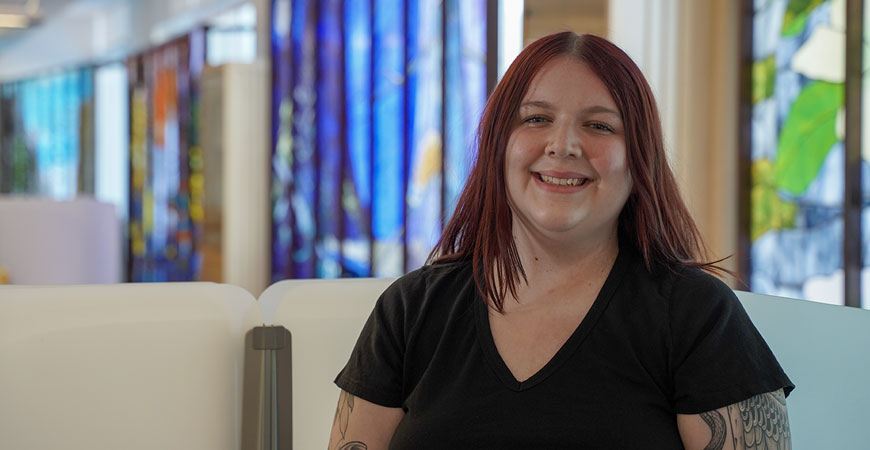
As a child of the Central Valley and a member of a Native tribe, Grace Grinder developed an early awareness of health care disparities affecting rural regions and underserved communities.
While in third grade, Grinder lost her grandmother to what she described as too few physicians nearby to provide timely, quality care. That loss planted a seed.
Today, Grinder is a third-year biological sciences major with an emphasis in human biology at UC Merced. She aims to be a physician. Grinder carries with her the lessons learned in Ripon, a small city about 12 miles north of Modesto, and through her roots as Karuk, an Indigenous people from the mountains and rivers of Northern California.
Childhood dreams about becoming a doctor were sharpened at Ripon High School, thanks to an anatomy and physiology class taught by a teacher named Ann Pendleton.
"Learning all about the human body and all of the different fields you can go into helped solidify that this is something I want to do, and that I can make a difference," Grinder said.
Conversations with Pendleton, along with stories from classmates whose families also experienced inadequate medical care, made clear to Grinder that the Valley needs more physicians — and that she could be one of them.
Her Karuk heritage added another dimension to that calling. Though the tribe's homeland is hundreds of miles north of Ripon, Grinder engaged with her roots through advocacy for Indigenous life and by recognizing that tribal communities face the same medical shortfalls as the Valley. Being a voice for underserved communities, she said, has always felt natural to her.
When the time came to choose a university, Grinder had options — many of them. The Native American Opportunities Program, which covers tuition for students with Indigenous roots, opened doors at schools across the state. She was accepted at six UC campuses, along with the University of Nevada, Reno. She chose UC Merced.
"I wanted to be a part of something where I could lead change for my community," she said, referring both to her hometown and to the relatively young UC Merced campus.
The university’s smaller scale, the approachability of the faculty, a sense that students could do far more than just attend classes — all of it resonated. She accepted her admission offer on March 1, the same day it arrived.
That instinct has paid off. Grinder said she is now on a first-name basis with most of her professors and has taken advantage of several opportunities.
During her second year, Grinder used a writing course to research the prevalence of human trafficking in the San Joaquin Valley. Her paper examined the shortage of resources available to health care providers and public health workers confronting trafficking in rural areas, and pushed back against the widespread tendency to underestimate the problem.
Today, she is vice president of Fashion Forward, a new student-run program built around clothing and community; a member of the crochet club; and an active participant in the American Medical Student Association. She serves as a mentor in the university’s medical education program, organizing Zoom calls and helping keep students on track.
She recently started working as a scribe at Memorial Medical Center in Modesto and will shadow a neurologist there — a connection she made through UC Merced's medical education mentoring program.
Statistics estimate that less than 1% of U.S. physicians identify as Indigenous Americans. Grinder wants to do what she can to move the needle, with UC Merced playing a big role in that effort.
"Every day I step onto this campus,” she said, “I know that I made the right choice."
 Public Information Officer

