


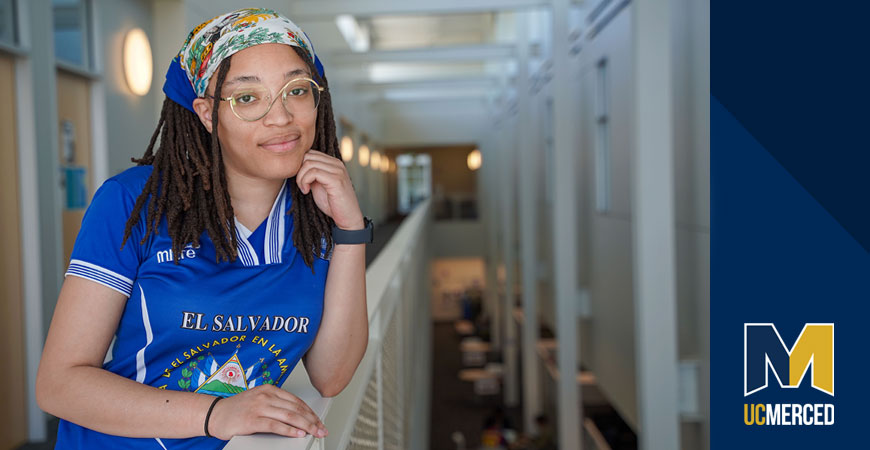
Taliyah Miller would be the first to tell you she arrived at UC Merced with an unwavering, long-range goal: become an anesthesiologist. What she could not have predicted was that a difficult roommate, a therapist’s question and a job she forgot she applied for would upend that goal and leave her better for it.
Miller was raised in Stockton, the third-largest city in the San Joaquin Valley. As the youngest of three with siblings several years older, it was like being an only child. She developed an independent personality early on.
All the Miller children attended Stockton Collegiate, a K–12 charter school. By 11th grade she was deep in its International Baccalaureate diploma program. She credited one course, called Theory of Knowledge, for preparing her for the future.
“That class set me up for college so well,” Miller said. “It touched on every single subject you learn in school and why we study them. I felt almost over-prepared for college coming in.”
Miller applied to nearly every UC campus with the aim of majoring in biological sciences and starting down the path to anesthesiology. UC Merced’s growing medical education program caught her attention, as did the financial aid package, which settled a final choice between UC Merced and the University of San Francisco.
Time for a Reset
“It felt like I could get a fresh start,” she said of attending the Valley campus. “I wouldn’t be far from home, but it was far enough for me to gain independence. I was getting a reset, which I really needed.”
Her first year went generally as planned. Her second did not. A conflict with a roommate sent Miller into a tailspin. She began attending sessions with the university’s Counseling and Psychological Services. What started as a response to a difficult living situation evolved into something more: a guided examination of who she was and what she wanted.
Her therapist made a game-changing observation: Miller seemed more interested in the history and culture behind biology than in the science itself. Sit in on an anthropology course, the therapist said, and see what happens.
Miller found that biological anthropology wove together what she loved about science with the historical and human dimensions she was drawn to. She switched her major to anthropology. She later added a second major in critical race and ethnic studies (CRES). The two disciplines spoke to each other, she said, particularly around anthropology’s complicated historical relationship with eugenics and indigenous communities.
The pivot changed everything. Her new double major felt like a conversation she had been trying to have her whole life. The crisis that brought her to counseling had reset her purpose.
Mentoring Other Students
Around the same time, Miller applied to be a peer navigator with the School of Social Sciences, Humanities and Arts. It was one of many campus jobs she applied for, so when a callback came from SSHA she scrambled to research the role before an interview. She turned out to be an ideal fit.
“Taliyah brings a positive and collaborative energy that students and staff naturally gravitate toward,” said Destiny Dias, a SSHA academic advising support specialist. “She is willing to step in wherever needed, and she approaches her work with professionalism and genuine care for the students she serves.”
The job altered the trajectory of her academic career in a second, quieter way. Working alongside other students to map out their degree pathways, she turned the same skills on herself. She ran her own degree audit, identified the overlap between her former pre-med coursework and her new anthropology and CRES requirements, and learned that graduating in four years was still achievable.
“I feel like it’s one of the most educational jobs you can have on campus,” Miller said of the peer navigator role. “Without it, I don’t think I would have known that I could double major and still graduate on time.”
Miller will walk in spring commencement, then complete two courses this summer to close out her degrees.
After graduation, she plans to take a gap year before pursuing a master’s in library and information sciences, with her sights set on archival work. It is a destination she found through anthropology and CRES, through a therapist’s insight, and through years of letting herself be surprised by where curiosity leads.
 Public Information Officer

