


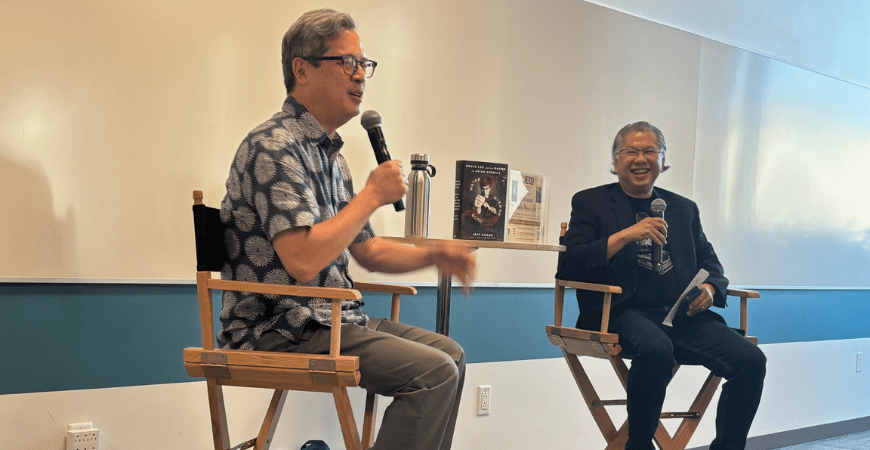
Bruce Lee's favorite dish was oyster sauce beef, and on the evening of May 7 it was on the menu at UC Merced, alongside a conversation about who Lee really was, why he still matters and what his story says about America.
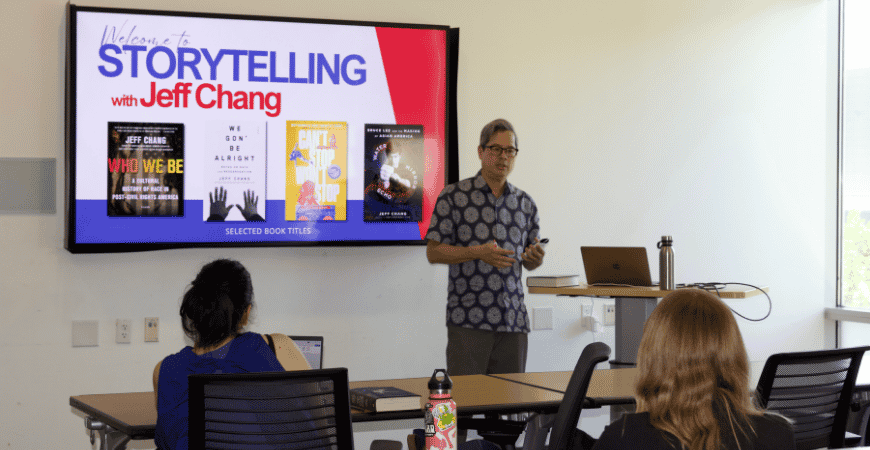
Jeff Chang, cultural historian and author of “Water Mirror Echo: Bruce Lee and the Making of Asian America,” was on campus as the featured guest of two events: UC Merced Dining’s Food for Thought Speaker Series and "Storytelling with Jeff Chang" at the Leo & Dottie Kolligian Library.
Chang’s visit as part of Asian American, Native Hawaiian and Pacific Islander (AANHPI) Month brought together students, faculty and community members for conversations about race, identity and belonging and an ongoing examination about who gets to be seen — and who gets to fight back.
“Bruce Lee put Asian Americans in the conversation,” Chang said. “Bruce built a body of (film) work in which he was always standing with the oppressed. He stood with laborers, with restaurant workers being pushed out by mob bosses, with anti-imperialists.”
The Food for Thought discussion was moderated by Bayani Jol Manilay, director of finance for auxiliary enterprises and fiscal innovation at UC Merced, and, as it turned out, an old friend of Chang's. When UC Merced Executive Chef and speaker series organizer Mitch Vanagten asked Manilay to moderate the event, Manilay mentioned in passing that he and Chang have been friends since their days together at UC Berkeley.
Bruce Lee and the Making of Asian America
The evening conversation touched on many threads that define the enduring power of Bruce Lee’s image, but Chang began with a fact that surprised many in the room: Bruce Lee was born in the United States.
In 1940, Lee’s father and mother were traveling in the U.S. as part of a Cantonese opera tour on the eve of war in China. His mother, pregnant during the tour, gave birth to Lee at the Chinese Hospital in San Francisco’s Chinatown before the family eventually returned to Hong Kong.
It was Lee’s move to the United States at the age of 18 that truly shaped him, Chang explained. Living in racially segregated communities in Seattle, San Francisco and Oakland for 12 years, he befriended people who had survived police violence and the Japanese American internment, and those relationships transformed his sense of who he wanted to represent.
Chang connected Lee's rise to the simultaneous emergence of Asian American identity as a political concept.
“Bruce came of age at the same time Asian America was coming of age,” he said. “In 1968, young Asian Americans were organizing against the Vietnam War and trying to develop a politic that felt true to their experience. Someone asked, ‘Why do we call ourselves Oriental?’ If you grow up in Asia or on the West Coast, the Far East is New York City or London. We're Asian and we're American. They came out of those meetings calling themselves Asian Americans.”
For Asians and Asian Americans, Lee's initial rejection from Holloywood, and what he built in response, carried a meaning that went far beyond film. "Before Bruce, images of Asian Americans were very stereotypical and very demeaning," said Chang. "After Bruce, there was a counterbalance to a century of these images of Asians as foreigners … or as a model minority, folks who are basically here just to serve others."
Chang noted that by returning to Hong Kong and becoming a superstar on his own terms, Lee did what Hollywood had insisted was impossible and proved what an Asian leading man could be. Chang described Asian American activists of the era watching Lee's movies alongside Black, Chicano and working-class audiences, with everyone erupting when Lee's characters refused to be humiliated or diminished.
"Bruce made us whole," said Chang. "He embodied us in all these kinds of ways.
"From ‘Talk Story’ to Published Writer
Earlier in the day, Chang shared a more intimate look into his own unconventional path as a writer as part of "Storytelling with Jeff Chang" at the Kolligian Library.
Growing up in Honolulu in a family of Chinese and Native Hawaiian descent, Chang developed an instinct for narrative through the Hawaiian tradition of “talk story,” a community gathering focused on food, drink and storytelling to share memories, oral histories and expansive legends.
That instinct took years to find its professional form. Chang graduated from UC Berkeley with a political track and worked in the California Legislature. He found the experience draining and would rediscover his passion during a return to college radio at UC Berkeley and then UC Davis, where he hosted one of the only hip-hop shows in the Central Valley in the early 1990s. The friendships he developed during the period, including artists who would go on to become major hip-hop figures, were the seeds of his first book, “Can’t Stop Won’t Stop: A History of the Hip-Hop Generation.”
When approached by an editor to write a new comprehensive biography on Bruce Lee, Chang shared that he was unsure about how to tackle the concept of celebrity biography. Although enthusiastic about the project, he described feeling overwhelmed by the sheer volume of existing material on Lee and uncertain what he could add. The breakthrough, he said, came during the pandemic, when a new generation's reclamation of Lee's image as a symbol of pride and solidarity in the face of rising anti-Asian violence made the book’s focus suddenly clear.
“This was a generation finding in Bruce Lee the figure they needed,” he explained. “That gave me my assignment — not a celebrity biography, not the ‘knock-them-off-the-pedestal’ genre, but something about why this figure keeps being claimed, across generations and across cultures.”
“And, of course, knowing you don't get paid until you turn in the final draft, that reality will always focus you,” he added.
Food for Thought: A Series Built on Connection
UC Merced's exploration of Bruce Lee as a groundbreaking symbol of Asian and Asian American representation began last year with Shannon Lee. The Bruce Lee Foundation chair and daughter of the martial arts icon visited campus as a Food for Thought guest speaker during Women's History Month to share her work preserving and expanding her father's legacy for new generations.
For Vanagten, who organized Shannon's talk and started reading Chang's book shortly after, the connection was evident. "Shannon's visit explored Bruce Lee's personal philosophy while Jeff's work expands that conversation into culture, history, activism and representation in America," he said. "It felt like a natural continuation of the conversation."
The reception at the recent event brought that theme of continuation to the table. Along with Bruce Lee's favorite dish, the reception featured recipes created by “Top Chef” alum Tu David Phu, who is among the first guest chefs Vanagten brought to Merced, before the Food for Thought series had fully taken shape.
"Chef Tu's willingness to engage with our community helped open doors for future guest chefs, filmmakers, authors and storytellers who have since become part of Food for Thought," Vanagten said.
The Food for Thought Speaker Series, including this year's AANHPI Heritage Month event, is supported by the UC Merced Division of Equity, Justice & Inclusive Excellence (EJIE).
"The series creatively promotes cultural awareness and community building by highlighting cuisine alongside the diverse lived experiences of groups comprising our state's population," said EJIE Vice Chancellor Delia Saenz. She noted that featured speakers address difficult topics such as exclusion, bias and hardship, while equally celebrating resilience, talent and cultural representation.
"This event, like others in the series, helps to foster community by bringing together students, faculty, staff and members from the community at large, in a space for learning and for breaking bread," she added.
 Public Information Officer

