


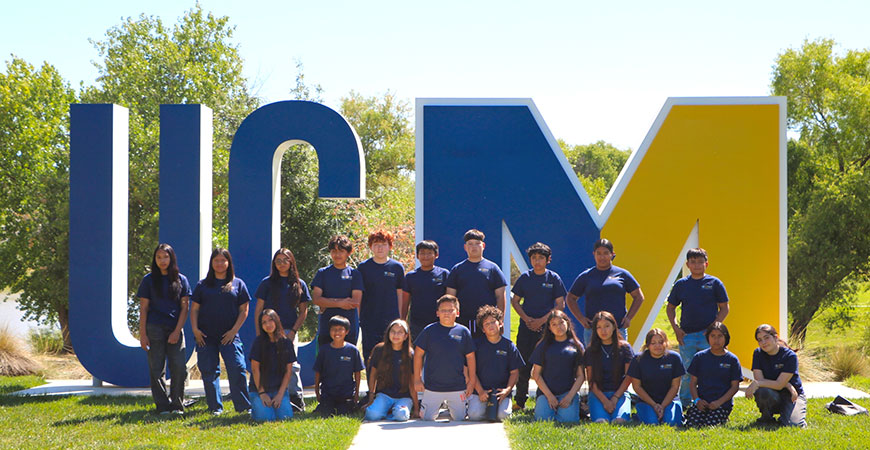
A new partnership between UC Merced's CalTeach program and the Bakersfield City School District gave middle-school children from migrant families a rare opportunity to live and learn on a college campus while exploring science in a hands-on, deeply engaging way.
The collaboration began when the Bakersfield program, called Migrant Education Program DFD21, contacted UC Merced to expand its efforts to expose students to higher education. Funding issues have shuttered similar programs elsewhere in California.
"Bakersfield chose to continue its migrant education program because of the demographic it serves," said Mariah Gonsalez, director of K-12 outreach and education for CalTeach. The district regularly partners with universities to create academies, free of charge, connecting students to mathematics, social-emotional learning and English language arts, she said.
At UC Merced, that vision took shape as a weeklong residential neuropsychology academy for 20 sixth-grade students at the beginning of June.
"We developed a neuropsychology academy focused on understanding the brain - how it works, development and sleep," Gonsalez said. "Students even dissected a real sheep brain."
For Marcel Guerra, a teacher with the Bakersfield City School District who works with the migrant education program, the academy represents something much larger than a weeklong academic experience.
"It's a big district: 44 schools, about 30,000 total student population," Guerra said. "Kern County has a strong migrant population. Our school district has several thousand migrant students."
The migrant education program, he said, is designed to help students whose schooling is often interrupted.
"The migrant program itself is a supplemental service designed to fill in the gaps from the moves. So, if they're moving for crops, for seasonal stuff, they're missing school. We not only supplement those learning gaps, but also supply life-changing opportunities like this."
Building trust with families is key to making those opportunities possible.
"We struggle sometimes getting the kids to show up. The moves affect a lot of them. But we have managed to create good relationships with our families, so there is some stability," Guerra said. "We build relationships with the families so that they trust us enough that they send the kids with us for a week for something like this, and the kids have a great experience."
A Week of Discovery
The program adapted an existing hands-on STEM curriculum to meet the needs of migrant students, incorporating math, English language development, reading and writing. All students in the cohort were Spanish speakers, and the academy was bilingual - a first for UC Merced CalTeach.
"It was the first residential program CalTeach has conducted at the UC Merced campus through Bobcat Summer STEM Academy," Gonsalez said. CalTeach students did the teaching, providing visiting students with another example of what their futures could hold.
"We're learning about how the brain works, like how it reacts when you have a feeling," said Yorshua Gonzalez, who hopes to go to college and become a soccer player like his hero, Cristiano Ronaldo.
For the students, navigating both science labs and life away from home, the week provided discovery, inspiration and a clearer sense of what is possible. Students stayed in campus housing, ate in The Pavilion and worked in scientific laboratories, while also taking part in recreational and community-building activities such as tie-dying their own T-shirts. They ended the academy with a signing ceremony, and all the students, instructors and staff signed the shirts as parting gifts.
Diego Perez Herrera said the campus left a strong impression.
"I like what I'm learning in the classes," he said. "I also like how everything looks here. It is clean and beautiful and there are lots of trees.
"I would like to go to college and learn more," he added. "There are many students who don't get the opportunity to go to college or don't want to go." Diego wants to be a firefighter.
Campus groups including La Familia met with students to talk about college life and "the experience of being first-generation college students and finding community on campus," Gonsalez said.
For Nikol Ramirez, the experience offered a first glimpse of campus life.
"I like how you can live here and work here and study," she said. It was her first time on a college campus. She hopes to study graphic design and animation.
Experiential Learning
The weeklong academy's instruction followed a student-centered, inquiry-based model designed to spark curiosity.
"Students explore first, relying on observation and curiosity, using 'I notice' and 'I wonder' questions to guide critical thinking," Gonsalez said. Concepts were introduced after hands-on exploration, then reinforced through labs and collaborative activities.
The results were encouraging.
"Students performed very well," Gonsalez said, noting that none had prior exposure to neuropsychology. She added that English learners may not typically have access to electives because they are taking English-as-a-second-language courses, which can limit the time for other opportunities.
For many students, it is a week full of firsts.
"You know, a lot of these kids have never been out of town or away from their family, so this is a big deal," Guerra said. "It has a huge, positive impact on their independence, their social skills."
Looking Forward
The work is personal for Guerra, whose upbringing keeps him connected to the community he serves.
His father was a pastor, their church was filled with migrant families and his parents are immigrants, he said.
"So doing this is kind of a no-brainer, you know?" Guerra said. "I dedicate my Saturdays and summers to the migrant program because these are my people."
Over the years, he has seen students move through the program and on to college, including participants who have attended universities across California. Those success stories reinforce the importance of experiences such as the UC Merced residential one, he said.
Following positive feedback from the district, UC Merced plans to continue and expand the partnership.
"We plan to offer this program again next summer, building on what we learned from this first residential experience," Gonsalez said. Future academies will explore new themes while maintaining a focus on accessibility and meaningful experiences for students.
 Public Information Officer

