


"We're still alive. We're still here. This history lives on in us."
For author and artist Gayle Romasanta, the story of Filipino American labor leader Larry Itliong is both a reflection of and a tribute to the Central Valley communities that raised him and the families who still call the region home.
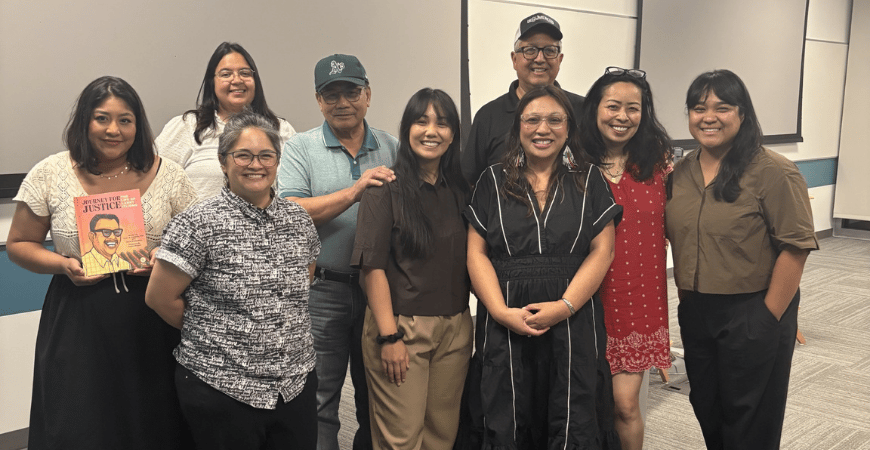
Romasanta, a Stockton native and co-author of the children's book "Journey for Justice: The Life of Larry Itliong," brought that message to UC Merced on Oct. 8 for "Rooted in Justice," a Food for Thought Speaker Series event held in celebration of Filipino American History Month. Moderated by Francesca Dinglasan, UC Merced's director of donor communications, the conversation ranged from labor and identity to the women who sustained the farmworker movement to the hard, ongoing work of solidarity.
"It's not just about Larry," Romasanta said. "It's about the communities we're part of and the communities that raise our leaders. Our communities shape who's going to lead us."
Growing Up Among the Manongs
Romasanta grew up in Stockton's Little Manila, and her grandfather and his relatives owned an 11-acre farm in Brentwood on the Delta. She was surrounded by manongs, pioneering Filipino immigrant farmworkers who labored in the region at a time when California law barred many Filipinos from owning land.
That upbringing, she said, shapes how she tells the story. Too often, she noted, writing about the manongs and the Central Valley romanticizes the history while overlooking the people still living it.
"These were our families and our relatives," Romasanta said. "So much of our history intersects in the Central Valley, in Stockton and Delano."
Itliong, she explained, came from a community that had been organizing for decades. Filipino workers who came in the 1910s and 1920s were mostly young men with no elders to guide them, and they began striking almost as soon as they arrived. By the time of the 1965 Delano grape strike, they had 30 to 40 years of organizing experience.
"You think farm labor means a small town, organizing a small community," she said. "This was absolutely national, at the center of human rights and politics. It turned global."
A Book, a Musical and a Friendship
The idea for "Journey for Justice" came from one of Romasanta's children, then a fourth-grader assigned to report on a famous Californian. No Filipinos were on the assignment list, and there was no children's book about Itliong.
Romasanta called a friend, Dawn Bohulano Mabalon, the first Filipina to earn a Ph.D. in history from Stanford and the author of "Little Manila Is in the Heart." Mabalon was planning an adult biography of Itliong, and the children's book was meant to accompany it.
The pair worked at a rapid pace, completing the book in about a year. On Aug. 10, 2018, the day they approved the final colors and sent the book to the printer, Romasanta learned that Mabalon had died. Mabalon left more than 800 pages of research, and the children's book remains her only published work on Itliong.
"I absolutely believe in ancestors, and that they guide us to do very specific things," Romasanta said. "I didn't realize this was something we needed to do in a very short time."
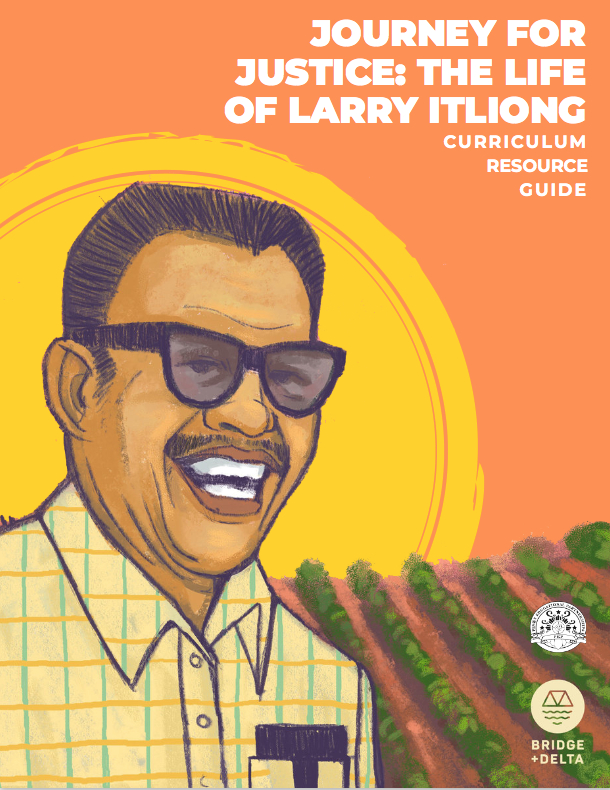
Illustrated by Andre Sibayan, whose murals can be found throughout SoMa Pilipinas, San Francisco's Filipino Cultural Heritage District, the book features historical photographs and signage from the era, including one that reads "Positively no Filipinos allowed." The book is now taught at San Francisco State University, Rice University and other campuses.
Romasanta noted that getting it published was a battle. "No one wanted it," she said. "Folks would say, 'Are you lying? We've never heard of Larry Itliong.'"
Her work on Itliong has since grown into "Larry the Musical," which she described as a love letter to the Filipino American community and to community organizing. The show follows Mabalon as she interviews Itliong and travels through his memories, and videos of songs from the musical were played throughout the evening.
One of the musical's protagonists is Izzy, a young Pinay organizer frustrated to find herself stuck in the kitchen while others lead. The women around her teach her otherwise.
"What her ego won't let her understand is that the kitchen is the heart of the movement," Romasanta said. "We organize by cooking. We organize by feeding everyone and loving everyone. That's why I love that food is part of this program."
During the audience Q&A, Romasanta expanded on women's often-overlooked leadership in Filipino American communities. Women ran the community queen contests and dances, she said, and those ticket sales paid for the basics that let the movement grow: utilities, food and nearly every community gathering.
"Whoever you are, please don't minimize women's involvement or their leadership," she said.
A Pot Big Enough for Everyone
In keeping with a Food for Thought tradition, the conversation continued over a meal inspired by the evening's themes. UC Merced Executive Chef and speaker series organizer Mitch Vanagten and his team prepared sinigang with rice, a dish Romasanta recommended. Made from inexpensive, adaptable ingredients, sinigang was a foundational community meal for Filipino laborers, who often lived together in camps. A single massive pot fostered a sense of family, and it could be stretched with extra water and vegetables so that everyone was fed.
Throughout the evening, Romasanta returned to kapwa, a Filipino value she translates as "I see you, you see me."
"There is not just me. I am you, you are me. We take care of each other," she said. "We inspire each other and keep going, through food, art, events, news, writing about each other and listening to each other's stories."
The farmworker movement Itliong helped lead, she reminded the audience, drew together African American, Mexican, Filipino, Yemeni, Jewish and Native American workers and supporters.
"This isn't just a Filipino story," Romasanta said. "It's for folks to understand that solidarity is so hard, but you've got to keep going."
The Food for Thought Speaker Series, including its first Filipino American History Month event, is supported by the UC Merced Division of Equity, Justice & Inclusive Excellence (EJIE).
 Public Information Officer

