


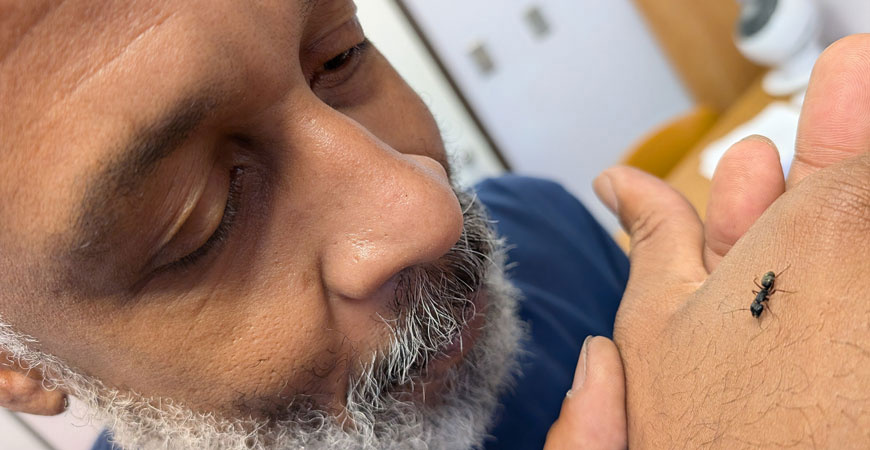
On most days, Reo Maynard’s life swings between two ecosystems: the microscopic world inside an ant’s gut and the sprawling one that stretches from Fresno to the Sierra Nevada mountains.
The 51-year-old Navy veteran, dad of two, screenwriter-in-waiting and newly minted Fresno City College faculty member is in his eighth year at UC Merced, earning his Ph.D. in Quantitative Systems Biology.
“I’ll be defending in May. The end is here,” he said, with the equal parts relief and wonder of someone who kept moving when the ground shifted beneath him.
Maynard’s work with Professor Gordon Bennett explores host-symbiont interactions, the intimate partnerships between animals and the bacteria that live inside their cells. His specialty is carpenter ants — “about as long as a penny,” he said — whose digestive tract houses endosymbionts that help process nutrients. Some of them are only found at higher elevations.
Fieldwork took him to Yosemite, Kings Canyon and Sequoia national parks — until COVID-19 shut the gates.
“I was twiddling my thumbs for two years and lost so much time,” he said. But the parks eventually reopened, and his projects evolved. Bennett said Maynard’s resilience helped him rebuild a dissertation in real time.
“He had to completely revise his dissertation after COVID. Ants were the only centerpiece that stayed,” Bennett said. “But he brought back cool projects and ideas and distilled nature to mechanisms — and he did it with a sunny disposition.”
From Virginia Beach to the Central Valley
Maynard’s path to science began far from the Sierras. He attended two years of college in Virginia right after high school, which he said was too soon for him.
“I just kind of screwed around and I ended up basically flunking out. They disinvited me to register for the next semester,” he said. He worked in the family insurance business for a while and then joined the Navy, determined to earn a degree the second time around.
He trained as a hospital corpsman, went to the School of Surgical Technology at the Naval School of Health Sciences, worked at the VA hospital in Chicago, picked up obstetrics and gynecology and trauma skills at Camp Pendleton and San Diego clinics, and specialized as a surgical assistant in obstetrics and gynecology at the Naval Air Station in Lemoore.
“That’s where I found my love for biology,” he said of his time in the Navy.
Before he went back to college, he worked for Kaiser Permanente for several years in surgical operations management, giving in to the lure of a six-figure salary.
He used his GI Bill to carry him through a bachelor’s in human anatomy and physiology and a master’s at Fresno State, where he worked with carpenter ants in a neuroscience lab. He interned for a summer in UC Merced Professor Fred Wolf's lab, working with fruit flies. He met Bennett through Wolf.
Bennett said that as a student, Maynard “has got a really wide-open mind about science, particularly the things we're interested in, like natural history and organismal biology.” He’s motivated, loves to be part of all kinds of discussions, brings new insights because of his diverse background and always wants to learn more, the professor said.
During his time in Bennett’s lab, Maynard earned the Howard Hughes Medical Institute’s coveted three-year Gilliam Fellowship, which supported his research and connected him with a national network of scientists.
“It was a good time — seminars, training, presenting our work in D.C. I really miss those days,” he said.
In Bennett’s lab, Maynard broadened his focus beyond ants to the bigger story of insect-microbe partnerships. He recently published his first paper on the genome of a carpenter ant endosymbiont he sequenced from high-altitude Sierra populations, above 7,000 feet. The finding: Even bacteria that should be near-clones, passed from ant mothers to daughters and sealed inside cells, accumulate tiny differences over time — differences that can change which nutrients and other services they provide their hosts.
“We think of mountaintops as islands,” Maynard said. “These ant populations are isolated, but their symbionts diverge in little ways that matter.”
If ants are Maynard’s muse, their microbes are the story. Endosymbionts — bacteria that live inside host cells — can shrink their genomes over time because life inside a cell is cushy. They shed genes they no longer need, becoming specialists that supply key nutrients their hosts can’t make or get from food. In isolated populations, those bacterial toolkits can diverge just enough to change an ant’s biology.
“Population A’s symbiont might provide a vitamin; population B’s might have lost that function and does something else,” Maynard said. “They should be clones, but random mutations add up. Our analyses are detailed enough to pick out those differences.”
Commuter, Caretaker, Closer
Through it all, Maynard lived and raised a family in Fresno — and commuted to Merced. When the parks closed, his kids were in grade school.
He and his wife, Deborah Bernal, Fresno County’s literacy coordinator, have two sons, Abram and Isaac, now teens juggling decisions about their futures: law or finance for Abram; engineering or acting for Isaac.
Perhaps a little envious of all the time they have ahead of them to make those decisions, Maynard is also considering law school.
Maynard laughs at his own willingness to give up free time.
“I’m a glutton for punishment, but it’s a challenge,” he said. “I can’t let them down. I want them to see I don’t give up.”
That commitment shows up in his classroom, too. Hired last fall to teach human anatomy, physiology and human biology at Fresno City College, he tells freshmen he started where they sit.
“We have Transfer Wednesdays,” he said. “Faculty wear their alma mater shirts so students can see there’s something beyond. I like pulling students aside, asking their goals, then holding them to it.”
Bennett said the match fits.
“He delivered one of UC Merced’s core courses — evolution — as instructor of record over the summer,” he said. “He modernized it, connected content to contemporary examples. The students really liked it.”
Next Chapters, Plural
The son of two teachers, Maynard’s life resists a single lane, though education, whether formal or self-taught, is a throughline.
He took four years of Latin in school and taught himself to speak fluent Spanish so he could communicate better with his in-laws. He is conversational in German, Italian, Japanese, French and even some Hebrew. His love for languages started when a middle-school friend from Israel wrote out the Hebrew alphabet for him. He later translated the entire Old Testament from the original Hebrew to English.
He also loves to scuba dive, a hobby he picked up while trying to get past a childhood phobia of open spaces.
He, Deborah and the boys travel widely and dream about Maynard taking a summer stint teaching at the American University in Berlin, where courses are in English and the city is a family favorite. They’ve been to Mexico, Hawaii, Germany, Italy, France, England and Japan, and as soon as this semester is over, they are going to Georgia and Armenia.
There’s also that potential next career as an attorney. The idea of building a practice with his son is attractive, and Maynard is considering San Joaquin College of Law’s evening program.
“When I was leaving my hometown, I flipped a coin between law and medicine,” he said. “I still wonder how life would be different if I chose law.”
And then there are the screenplays he has written — six or seven full drafts and a stack of fragments, from a rom-com presidency-reveal to historical drama and a “Star Wars” story. Once the dissertation is done, he plans to finally produce and direct a 30-minute short he’s scoped and budgeted.
Through it all, the ants keep marching. In his office at FCC, Maynard maintains 13 colonies and a single queen who has yet to lay eggs.
He keeps writing, teaching and parenting on a schedule that would flatten most.
When asked what drives him, Maynard said he thinks he has some anxiety about not getting things done, plus a love for personal challenges.
“I have to make sure that I don't fail myself. I don't fail my sons. I don't fail my family, you know?” he said. “Plus, if I can do this, what else can I do, you know? Why ever stop? I just want to keep going. What else can I do?
How Maynard does it all, Bennett said he does not know, but he is inspired to try and do as well with his own two boys.
“They are always his first priority,” Bennett said.
Bennett counts Maynard as one of his friends, and said he is actively looking for projects to keep the two of them collaborating.
One thing he knows for sure is that Maynard will be missed in the lab when he graduates in May. Bennett has no doubt his student will succeed.
“His resilience is really an inspiration for other students in the lab community,” Bennett said. “He is hungry for knowledge about everything. Everything. That kind of curiosity is rare.”
Lorena Anderson

Senior Writer and Public Information Representative
Office: (209) 228-4406
Mobile: (209) 201-6255


