


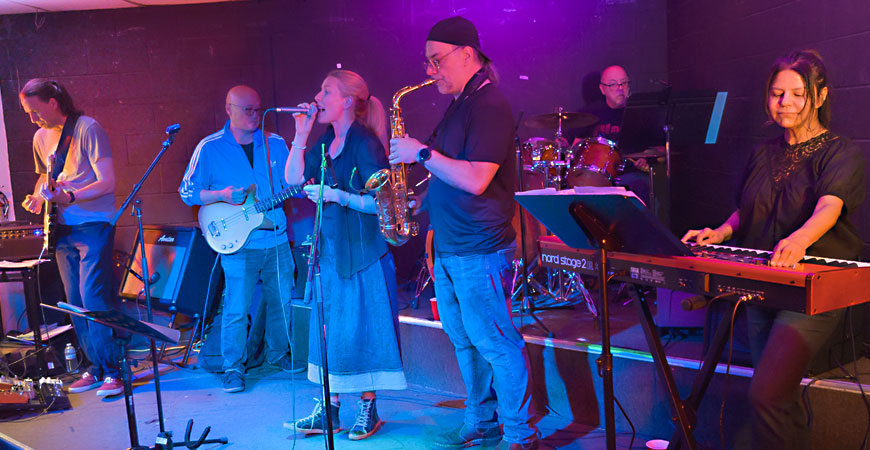
An all-faculty rock band formed in a professor’s garage a decade ago has released the first album produced at UC Merced’s digitally advanced recording studio.
The album showcases the eight members of G Street Revolution. Their day jobs cross a spectrum of academics: engineering, sociology, mathematics, music and writing. The album, their first, is called “Dumpster Fire.”
The recording studio is in the Arts and Computational Sciences Building, near rooms devoted to the Global Arts Studies Program. ACS has a film screening room, a dance studio, and spaces for student musicians.
Professor Jayson Beaster-Jones, a co-founder of G Street Revolution, said that every evening during the school year, ACS thrums with the energy of dance groups and bands as they go through their paces.
“This building at night is rocking,” Beaster-Jones said. “It’s very, very busy.”
It was here that G Street Revolution logged about 10 weeks of recording and mixing, stretched over about a year, to complete “Dumpster Fire.” Work on the album wrapped in April.
G Street Revolution — the name refers to a Merced thoroughfare and the spinning of vinyl records — has played live nearly 70 times in 10 years at venues around Merced County and in support of UC Merced events.
“Dumpster Fire,” like the band, defies narrow categorization. One could start with “alternative rock,” only because “alternative” allows whatever the band pours into it. Several G Streeters have roots in jazz and blues. They all lean into sophisticated arrangements and give every instrument a spotlight.
The album is full of chunky bass lines, swinging keyboards and a nimble-footed lead guitar. Professor Tea Lempiälä and Teaching Professor Paul Gibbons provide vocals as solo leads and in harmony.
Topping off the sound are the croons and barks of two saxophones. Yes, these rockers have horns.
“That’s fairly unusual,” Beaster-Jones said.
The lineup:
-
Beaster-Jones (saxophone), music professor
-
Gibbons (lead guitar, vocals), writing studies teaching professor
-
Lempiälä (vocals), management of complex systems professor
-
Arnold Kim (bass guitar), applied mathematics professor
-
Nella Van Dyke (trombone, percussion), sociology professor emeritus
-
Patricia Vergara (keyboard), ethnomusicology professor
-
Byron Webb (drums, vocals), Merritt Writing Program lecturer
-
Caleb Westby (saxophone), music technology lecturer
Colleges and universities are a rich source of all-faculty music groups. Questionable Authorities, a punk rock band, have head-banged in and around State University of New York-New Paltz since 2003. Christopher Newport University has the SEC Band (as in “School of Engineering and Computing”) and Florida Gulf Coast University the Immokalee Road Band.
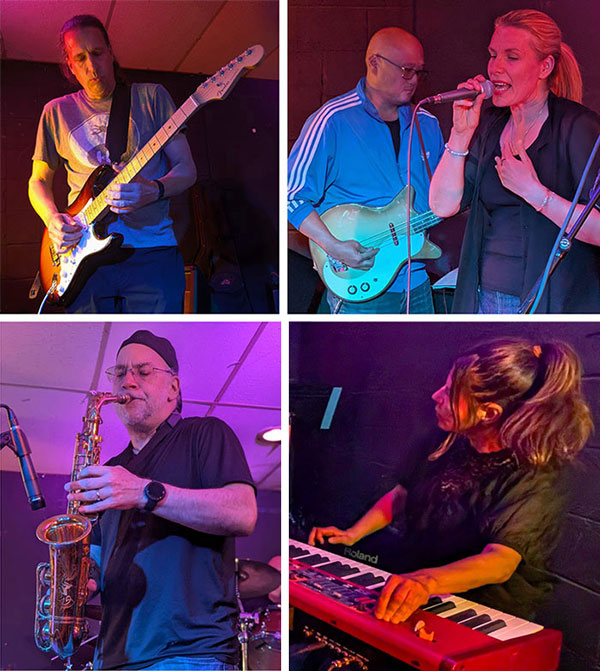 In 2015, Beaster-Jones and Gibbons were introduced to each other at a UC Merced faculty meeting. Soon after, Gibbons brought his guitar and Crate amp to Beaster-Jones’ garage for a jam session. Things began to click. Webb, who had played with Gibbons in another band, was brought in as a drummer.
Webb, who teaches courses in academic writing, said playing in the band is like composing poetry. “I love bringing in songs I write to see what these great musicians can contribute to them,” he said.
The band’s first gig was in May 2016 at Lake Yosemite. Members came and went over the first few years, but the lineup has been largely stable since 2019, Beaster-Jones said.
Because of members’ years of teaching and playing in classrooms and band rooms, rehearsals have a higher register than most bands are used to.
“For instance, Patricia has some of the best ears I’ve ever encountered,” Westby said. “She’ll drop something like, ‘Hey, whoever’s playing the flat nine on this chord, could they do a sharp 11?’ Versus other rock bands where it’s like, ‘Hey, that sounded weird.’”
Creating “Dumpster Fire” satisfied several goals beyond being the first album recorded at the ACS studio. For the music academics in the band, it was a form of publication, similar to a book or research paper. It also preserved some of their original work, including songs written eight or nine years ago (usually, about 70% of the music at G Street shows is theirs, Beaster-Jones said).
There’s also the joy of sharing their music more broadly. The album is available on popular services such as Spotify, Apple Music, Pandora and Amazon Music. That reach matters especially to Lempiälä, a native of Finland who has family and friends thousands of miles away. “For all the people who can’t come and listen to us live, to be able to share it, well, that’s wonderful,” she said.
“I love bringing in songs I write to see what these great musicians can contribute to them."
Westby, whose background includes concert band composition and creating “weird, electronic music that would get you thrown out of a bar in 1960,” served as the engineer. He had some recording and editing chops but had never applied them to G Street’s type of music.
“It was a great opportunity to try new strategies, to put the rubber to the road and see what I can do,” Westby said.
Over two weeks, the full band recorded the songs live in the ACS. Each member played in a separate room, connected by headphones and monitors, to isolate their sounds. “There were wires sticking out of doors and going down the hall … maybe the fire marshal doesn’t need to read this story,” Westby said.
This created a “scratch track” — a structural blueprint for the songs. The studio’s soundboard has 16 recording tracks but Westby was able to expand that to 18. Bar by bar, verse by verse, solo by solo, the band recorded takes that built up “Dumpster Fire.”
Student interns helped keep the wheels turning with tasks such as documenting microphone placements and volume settings after takes, or making backup recordings on a Mac desktop.
The result of all this attention to detail is an album that covers a lot of territory in 33 minutes.
The title track was written by Gibbons in late 2016. He said the lyrics, aimed at “rampant narcissism” and worship of wealth, are as relevant today as they were then.
“It’s pointed at a person — a ‘you’ — but it could be anyone with those traits,” he said.
Some take to flight or they fall on the road
Some go into the light and do what they’re told
Some slide over like birds on a wire
Some die by candlelight and others
In a dumpster fire
“Stand Back,” with strutting horns backing Lempiälä’s plaintive vocals, skewers the scourge of mansplaining. The lyricist, Kim, said it was a challenge to write for a woman’s voice. “The subject just kind of came to me and I ran with it,” he said.
“Simple Bees of Rain” is a bluesy Gibbons-Lempiälä duet with Gibbons on acoustic guitar and he and Beaster-Jones trading solos on lead guitar and sax. “2020s Blues” combines wildfires, COVID and political tension as “the poison in the air.” “G Street Strut” is an instrumental that, true to G Street Revolution’s vibe, pushes boundaries and gives everyone moments to do their thing.
“Most of the time, when folks form bands, they want to go somewhere with it. They hope to be commercially legible,” Vergara said. “In our case, we can do whatever we want. If I do a jazz solo in the middle of a song, they usually say, ‘Do more of that.’”
 Public Information Officer

