


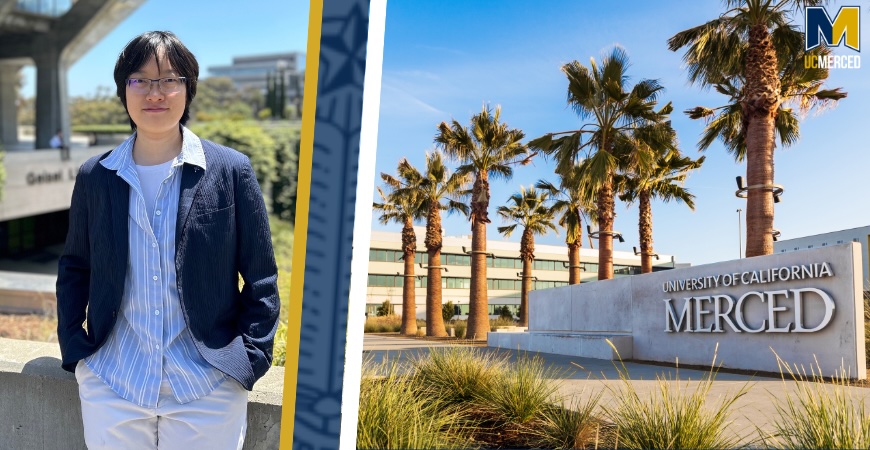
From smartphones to medical devices, artificial intelligence is a part of much of everyday life. One of UC Merced's newest professors is working to make AI more explainable and more efficient.
Electrical engineering Professor Xiaofan Yu started at UC Merced this summer after graduating from UC San Diego with a Ph.D. Originally from China, Yu earned her undergraduate degree at Peking University. She said she is excited about the opportunities UC Merced offers.
"I'm thrilled to begin my dream job as a tenure-track assistant professor and to start building my own research group," Yu said. "The energy and dynamism of UC Merced, as the youngest UC campus, perfectly align with this exciting stage of my career."
Yu's research focuses on embedded systems and edge AI.
"Embedded systems are dedicated computing systems designed for specific applications - ranging from smartphones and smart home sensors to agricultural and medical devices," she explained. "Edge AI, on the other hand, explores how we can integrate artificial intelligence into these systems to enhance their capabilities while operating under strict resource constraints."
She said she can understand why people have concerns about AI.
"It seems like a black box," she said. "It's hard to understand what's going on."
At the core of her work is designing algorithms and system deployments to bridge the gap between intelligence and efficiency.
While those terms sound computer science-centric, Yu said her work is collaborative and crosses numerous areas of study.
Designing embedded systems draws upon expertise in machine learning, natural language processing, computer architecture, mechanical engineering and even cognitive science.
"For example, in agricultural applications, we need to collaborate with growers and farming companies to identify practical challenges and convert them to a technical problem we can solve," she said. "In medical settings, we would need to work with doctors to understand clinical workflows."
While obtaining her Ph.D., Yu created a chatbot that enables users to interact with sensor data using informal language, answering questions such as, "How long did I spend in meetings today?" or "How is my work-life balance?"
At UC Merced, Yu said she looks forward to continuing to build cross-department collaborations and exploring new, impactful projects together.
"We are very pleased to have Professor Yu join us, bringing her energy and exceptional skills," said Professor Sarah Kurtz, chair of the Department of Electrical Engineering. "I expect students will find her research to be relevant and fun."
She is actively recruiting two Ph.D. students for next fall and multiple undergraduate researchers, who could start anytime.
"During my Ph.D., I had the privilege of mentoring around 40 students at all levels - from high school to Ph.D.," Yu said. "It's always fulfilling to see students grow and reach their potential. I've mentored a high school student who went from being hesitant about coding to enjoying programming for bio-analytics projects; an undergraduate in Tijuana who became the only student in her class to pursue graduate studies; and another who started with no PyTorch (machine-learning framework) experience and went on to lead a first-author paper in his senior year and begin a Ph.D. last fall."
Yu said her lab isn't limited to electrical engineering majors.
"I am looking for motivated students who are passionate about working on hands-on problems, especially students who are interested in this intersection of software and hardware," she said. She welcomes computer science students, mechanical engineering and cognitive science majors, and undergraduates with a perspective on efficiency or sustainability. "They would need some coding experience or be willing to learn. I am happy to work with students who are eager to learn."
More information about the positions in Yu's lab is available at her website .
 Public Information Officer

