


Starting next summer, UC Merced will join an elite group of University of California campuses hosting COSMOS — the California State Summer School for Math and Science — giving some of the state’s most talented high school students a new destination for exploring advanced STEM fields.
Established by the California Legislature in 1998, the prestigious program gives top students from across the state the chance to work with UC faculty, researchers and graduate and undergraduate students on advanced science, technology, engineering and math (STEM) topics that go far beyond the standard high school curriculum.
Current COSMOS sites are UCs Davis, Irvine, Los Angeles, San Diego and Santa Cruz. UC Merced’s addition reflects both the growing demand for the program and the university’s mission to expand educational opportunities in the Central Valley.
“UC Merced’s addition mirrors the geographic and academic diversity the UC system offers,” said Niels Grønbech-Jensen, a UC Davis distinguished professor of mechanical and aerospace engineering and mathematics who serves as executive director of COSMOS. “It is crucial for COSMOS to be geographically representative of California. UC Merced, in the San Joaquin Valley, will serve a geographically important role in this representation.”
With nearly 9,000 applications for about 1,000 spots each year, COSMOS is among the most competitive pre-college programs in the state. The average GPA of accepted students is 4.0, and applicants rank among the top students at their schools.
Building Opportunity Close to Home
UC Merced’s COSMOS program will be led by Professor Michele “Nish” Nishiguchi, a molecular and cell biology faculty member, with Bobbi Henderson serving as assistant director. Together, they are developing an experience designed to inspire high-achieving students across California to pursue higher education in STEM.
“The program allows UC Merced to provide research opportunities and exposure to college life for top-performing high school students across the state, including in our own community,” Nishiguchi said. “It’s an extension of our commitment to ensuring that academically excelling students in our region get the best possible preparation for success.”
Michael Findlater, interim dean of the School of Natural Sciences, said the program aligns perfectly with UC Merced’s mission to uplift the region through education.
“By offering high school students hands-on research experiences and a glimpse into college life, we can inspire the next generation of scientists and engineers, particularly from underrepresented communities in the San Joaquin Valley and beyond,” he said. “As a growing research institution, UC Merced is thrilled to be part of COSMOS.”
How COSMOS Works
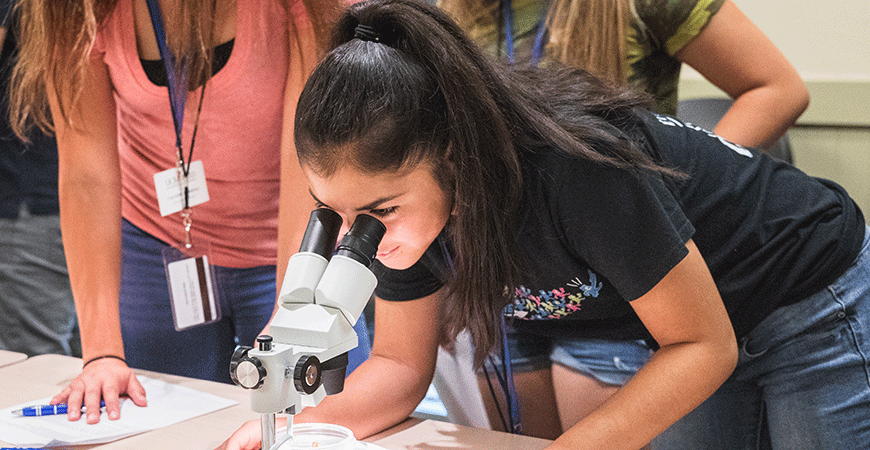
COSMOS is not the typical summer camp. Students live on campus for four weeks, taking part in research clusters, or focused academic groups, each led by UC faculty members and supported by graduate and undergraduate mentors.
Each cluster enrolls 20 to 25 students who dive deeply into STEM topics and work on real-life projects and challenges. They are in class from 9 a.m. to 5 p.m. and evenings and weekends are filled with team-building and social activities — from “lab Olympics” and pickup soccer games to field trips, possibly including Yosemite National Park.
By the program’s end, students present their results at a research symposium attended by faculty, peers and their families.
UC Merced is launching with seven clusters:
- Experiments in Soft Matter at UC Merced: Complex Fluids and Flows
- Nanomaterials for Accelerating Chemical Reactions
- Exploring Materials
- AI at Scale
- Glowing Partnership: Exploring Bacterial-Animal Symbiosis Through Bioluminescence
- Digital Twins-Making Things Smarter
- Quantum Materials & Light: Illuminating the Weird World of 0D and 2D Materials.
For faculty, the program is an opportunity to teach California’s most motivated high school students — and to design creative courses around their own research.
“It’s not an easy task,” Nishiguchi said. “Faculty had to think about big questions but narrow them down to one doable project at a high school level for four weeks. But it’s a great challenge.”
Nishiguchi and Henderson visited UC Davis’s clusters last summer and said they saw students building robots and atomic microscopes and modeling the spread of HIV as they wrote their own computer code to make the simulations function.
“I hope we get students applying from the Central Valley, but also from other places — like the mix we have on our campus,” Nishiguchi said.
At UC Davis and other campuses, faculty members have praised COSMOS students for their focus and capability. Many professors report needing to raise their game because the students perform at a much higher level than anticipated.
“These students want to be here,” Nishiguchi said. “That’s what makes the program enjoyable for everyone.”
Nishiguchi said the experience can be transformative for students.
“These kids are all such high achievers. They are used to being the smartest people in the room, and then they realize they’re in a room full of people who are just as smart. They learn to work together. It’s good for them,” she said.
A Legacy of STEM Leadership
Since its inception, COSMOS has played a vital role in cultivating California’s STEM talent pipeline. The program was modeled after the California State Summer School for the Arts and created by the Legislature to engage “the most creative minds of the new generation” in science and mathematics.
Data from other campuses show that COSMOS participants often go on to enroll at UC campuses and other top universities. The UC undergraduate application even includes a section for applicants to indicate they are COSMOS Scholars.
The COSMOS program not only prepares students for future academic success but also helps them build teamwork and leadership skills in a supportive, research-oriented environment, network and get a taste of college life.
Grønbech-Jensen said the classes help students connect their learning to real-world applications — and to each other.
“Academically, students experience a curriculum that addresses a complex problem that requires multiple STEM disciplines to comprehend,” he said. “Socially, COSMOS often fosters camaraderie that goes far beyond the four-week stay. The residential experience can also be very important for students who have never been away from their parents for extended periods, and it is a great trial run for what it is like to live on a campus.”
Support for Students and Faculty
The program’s cost is $6,000 to $7,000, which covers tuition, housing and meals. However, financial aid is available to ensure that all admitted students can participate, regardless of family income. Acceptance is only based on academics, Nishiguchi said.
Funding from UCOP will help UC Merced launch its first year. UC Merced’s first COSMOS session will begin July 5, 2026. The campus is working closely with UC Davis to ensure a smooth rollout.
Students will apply to the program in early January and will have a choice of clusters from all six campuses.
Both Henderson and Nishiguchi expect UC Merced’s program to grow, and Henderson said UC Merced might also have opportunities to host additional clusters in future years — particularly in 2028, when UCLA’s COSMOS program may pause due to the Summer Olympics in Los Angeles.
“We were thinking maybe some of their faculty could bring their clusters up here,” Henderson said. “That would give students more clusters to choose from and could lead to new collaborations between our faculty and UCLA’s.”
For UC Merced, the arrival of COSMOS marks a major step in expanding access to high-level STEM education — not only for the state’s top high school students but also for the region’s future scientists and innovators.
Lorena Anderson

Senior Writer and Public Information Representative
Office: (209) 228-4406
Mobile: (209) 201-6255


